Master Silver Smith Haddon Hufford

 Brian D'Ambrosio is a writer/editor living in Missoula, Montana. D'Ambrosio is the author of more than 300 articles and five books related to Montana history, people, and travel.

*****************

Lost wax casting. Synclastic raising. Anticlasting raising. Hollow construction.  Haddon Hufford speaks the vernacular of the silversmith with a lexicon centuries old. Common terms: annealing, engraving, chasing, planishing, polishing, raising, repoussage, sinking and soldering. 

Spend a few hours with Hufford in his quiet, rustic Frenchtown home and studio and his encyclopedic knowledge of the craft makes you feel badly uninstructed. With a rough-hewn scholarliness, Hufford explains that ‘annealing’ is when metal is heated for altering. ‘Planishing’ is the act of using a highly polished hammering to refine metal surfaces. ‘Raising’ shapes a hollow form in the metal. 

Hufford is the consummate teacher, sharing definitions and histories with thoughtful regularity. One minute he could be discussing the colonial artistry of Paul Revere, and his “first copper rolling mill”. The next, he describes how to imprint and texture a design into metal.  From there, there is talk of sinking (hammering the metal to create a concave hemispherical shape), and soldering (connecting metal with a low temperature heat). Hufford’s sentences are not haphazard slivers of verbiage, but more like authoritative pronouncements.  

“Silversmithing in many ways is the forcing of metal into new directions, directions it may not wish to go,” says Hufford. Looking at Hufford’s work, you glimpse silversmithing’s ancient endearment, intense difficulty, and unique beauty in a single handsome piece. On one table stands a pair of sterling silver candlesticks, with a long tapered, hammered stem, and a spiked candle holder. Contemporary candelabras, its finish both hammered and polished, with a ball and jutting arms for tapered candles. Hufford’s craftsmanship articulates the flurry and force of a man who pays stout attention to details. 

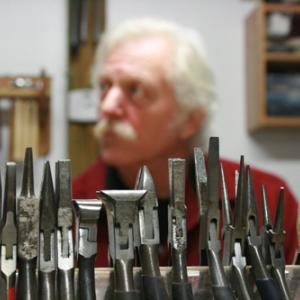
Many of the tools used in ancient times are still used by modern silversmiths. Ancient tools Hufford finds familiar include tongs, hammer, anvil, engraving burins, small mallets, large scales, weights, and blow pipes. Hufford’s studio walls are lined and stacked with dozens of different shaped hammers and mallets, each with its own distinct impression. Also displayed in his shop are specialized hammers, anvils, and metal working stakes, many of which are hand-made. 

Tools alone are simply tools. It’s the craftsman who breathes creative life into them, who understands their purpose, perpetuates their methods. There is something revelatory in seeing the two together, an almost Pentecostal feeling of seeing in tongues. Hufford says that each hammer’s shape and style leaves its own distinction. Mental conditioning is important, too. Metal moves at such a leisurely pace; hammers slowly form their outcome.

Arms tire and the mind needs to be attentive to the body’s needs. It is written that sometime in the Middle Ages a rift between goldsmith and silversmith took place. Silver was plentiful, less costly than gold. Individuals starting out could not afford gold as their working medium. Goldsmiths became highly revered. They often served as the local banker, whereas the silversmith took the goldsmith’s training and began a new trade commodity.

Hufford’s art is the continuance of that split. Hufford has lived in the woodsy hills of Missoula Valley since 2006. He was born and raised in New York's Hudson River Valley, studied graphic design at Parsons School of Design in Manhattan, before serving in Vietnam as a combat cameraman in the Army's 1st Air Cavalry Division, from 1969-71. Hufford then trotted the globe in the subsequent twenty-eight years, working in the film industry as a dolly and crane grip and set builder (he worked on at least 75 films). 

His journey into metalsmithing began serendipitously on a trip through Argentina in 1996. In a tiny village on the Pampas, Hufford visited a silversmith's workshop and become fascinated. Wonder is a measure of what this world is all about. In that South American shop, Hufford learned that wonder could be an antidote to the chaos of the world.  

“There were three silversmiths in town,” says Hufford. “One of them invited me in to his studio. It was a powerful and exciting exhibition. I came home and I got started.” Sterling is his material of choice because of its inherent beauty and value; it requires Zen-like endurance forming and forging noble metal. Hufford says, "I know that the blow from the smith's hammer is directly related to the heart beat and rhythm of life itself. 

There are times in the solitude of my studio when hand and hammer become one and the repetition of the overlapping blows brings me to the point of meditation."

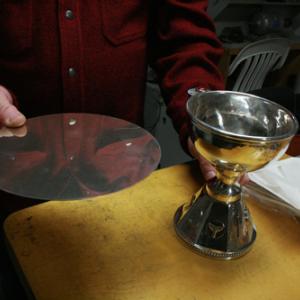
Techniques used to join silver together include welding, soldering and brazing. Hufford’s silversmithing incorporates the skills he obtained in the workshops and homes of craftsmen across the world, an Irish metalsmith, a Bulgarian silversmith, a New York jeweler. A desire to follow an abiding sense of curiosity opened up an entire new world of shape, form, and creation. Some of his forms are common finely metal-smithed forms: letter openers, candelabras, goblets, and vessels. Each hand-wrought piece that Hufford forms is original, masculine, and ordinarily geometric, and he is proud to have not once duplicated an object.  


All of Hufford's work is either created on commission or sent to Lauren Stanley American Silver gallery in New York City. No matter where they go from there, they will remain fragments of Hufford’s experience, accounts of his spiritual and artistic growth.

Silversmithing, like life, allows for the possibilities of transformation, a daily opportunity for Hufford to experience the vigor of the everyday. Its enduring link to man’s innate desire to shape and create something eye-catching isn’t lost on Hufford. “Silversmithing goes in and out of vogue,” says Hufford. “But I think that silver has, and always will, connect to people. Think about it, candlelight, a glass of wine, a great dinner, and silver, hand-wrought candleholders. That says it all.”

This Robin Knows Real Estate

By Kathleen Clary Miller

Kathleen Clary Miller has written 300+ columns and stories for periodicals both local and national, and has authored three books (www.amazon.com/author/millerkathleenclary). She lives in the woods of the Ninemile Valley, thirty miles west of Missoula.

*********

I’ve been watching the same red-breasted robin for three years as he frenetically builds enough abodes to have us believe an entire flock of male robins must have made them.  When we discovered it was only one doing it, we were amazed. 

I’ve nicknamed him our “OCD Robin” because my husband and I can’t help but observe his rather obsessive-compulsive dedication as he hustles and bustles, bumping into windows while completing construction…after construction…after construction.

As opposed to careful plan, there is sheer determination.  Zooming back and forth at lightning speed, in mid-flight he hastily tosses twigs, weeds, and even dog hair into what resembles several growing piles of debris that are suddenly then transformed into cozy dwellings.  As soon as one is secure, he is onto the next, all day long.

We noticed evidence of his condominium-style approach the first spring we lived here: a straight line of units the length of a wooden beam above our breezeway that leads to the shop, ten or twelve wall-to-wall nests.  It took awhile to realize they all belonged to just one bird.

I pointed out the plethora—and what I thought the product of a psychologically disturbed avian— to our friend who has a PhD in zoology.  “I think we have a bird with OCD,” I chuckled as spring was coming to a close and our robin was busier than ever.  So many nests; so little time.

“He’s trying to attract a mate,” Charlie informed me.

Poor guy.  Apparently instead of OCD, we were dealing with a unabashed wallflower capitalizing on the odds:  Build enough of them, and she will come!  Proof of industry was certainly visible in his labors of love but, sadly, no takers.  Women are picky.

Last spring, he spread his wings and tried a few new spots, and his tempting nests looked tidier.  After repeating floor plans atop the past year’s failures, this time around, he added even more:  one had a breathtaking view of the forest from our back patio; another a sylvan arboreal ambiance on a tree branch.  You know what they say:  location, location, location…and in his case, location, location, location, location.  

Lo and behold, early one morning I heard the shrill peeps that signal fledglings.  Even though I never saw her, some fortunate female had obviously responded if not to his charms, at least to one of his more charming villas--even if now that the kids were here, she was making herself scarce. 

Predictably, this year as spring warms the air, he’s back at it, banging into my office window on hasty approach to the sill above it, sticks and stalks flying about and falling down.  Like the little engine that could, failure does not discourage; he tries, tries again.  Within minutes of groundbreaking on this one, he’s off to the front porch where within the hour he completes two more nestled in the angles of the truss.  When I walk to the garage, there he is, hopping down the breezeway at breakneck speed.  He pauses only for the split second it takes to lift his eyes to former building sites now razed by winter storms.  He freezes until I pass but once I am in the garage, I hear from those rafters the rustling that can only mean rebuilding. 

“He doesn’t have OCD,” I decide and tell Brad.  “He suffers from sexual addiction!” 

“He’s a hard little worker; that’s for sure,” Brad sympathizes.  “He’s working like crazy to get a girl.”   Or is it girls, as in plural, I wonder.

With this year’s addition of several even more enticing vistas (the floor plan outside my office abuts a blossoming tree that after sunset smells intoxicatingly of honey) he’s bound to bewitch a harem.

The early bird may snag himself the worm, but the bird that never sleeps gets the women.


Tri-athlete Linsey Corbin

Brian D'Ambrosio is a writer/editor living in Missoula.

*****************

When the mind is without clarity it cracks. When the mind lacks stability it quakes. When the mind lacks inspiration it sleeps.

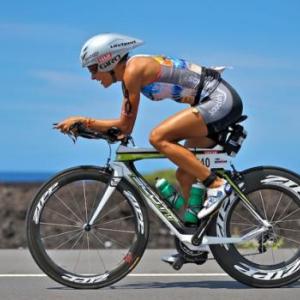
In order for Missoula triathlete Linsey Corbin to succeed, her mind must shine like jade. It needs to elevate her on lowly days and inspire her when she is feeling alone, fatigued, or out-of-sync. If it’s corrupted by fear, self-doubt, or frets about steep terrain or stiff competition, she would stumble.

She hasn’t slipped yet.

In fact, mental tact has pushed Corbin into a top ten finish in more than ninety percent of her races.

“Being a triathlete is almost more of a mental event than a physical one,” says Corbin, who has competed in sixteen Ironman competitions. “Physically, we are all on an even playing field. But, mentally, you would be surprised by what you can do once you can set your mind to it. It helps me to be open to surprise and positive.”

As part of that mental preparedness, Corbin trains, or, well, un-trains, the thinking process. She puts herself in uncomfortable training situations and mentally equips herself to handle all the psychological distractions and discomforts she expects to encounter on race days.

Some of the more challenging items: a healthy dose of pre-race nerves; fickle or extreme
weather patterns; underestimated terrain; and concerns about calories, digestion, and the other competitors.

Her head, her nervous system, her eyes, her senses and her body – these do not encounter the external environment. They are the external environment.

“When I train, I try to focus on the things I can control, like breathing, cadence, hydration,” says Corbin. “I don’t focus on those things not in my control. I try to break (thoughts) down to simple things, and just get to the next mile. I find smaller components work for me. A lot of these lessons I find applicable to life.”

Corbin grew up in Bend, Oregon, with aspirations of winning Olympic Gold as a ski racer. Years ago, however, she realized that her body type and personality were better suited for cross country and track competitions. After hanging up her cleats, she landed at the University of Montana, studying nutrition and exercise physiology. A few years later, she ratcheted up the intensity, and became a professional athlete.

It seems only natural that Missoula has cultivated Corbin’s athleticism, for it provides uniquely natural training environments. From Pattee Canyon to Mount Sentinel, the city slickly balances mental fortitude with top physical fitness. And its 3,500-feet elevation and plethora of surrounding trails, canyons and ridges, are the stuff of great teaching opportunities and sharp regimens.

“I love training and living in Missoula,” says Corbin. “The thing about Missoula is that there is no pretentious limelight and a great balance. The city has a nice identity and no place compares to Missoula.

“From an athletic standpoint, there are lots of humble athletes here, ultra-distance runners and medalists. It has incredible bike riding, and once you leave, you can go one hundred miles and see only one stoplight.”

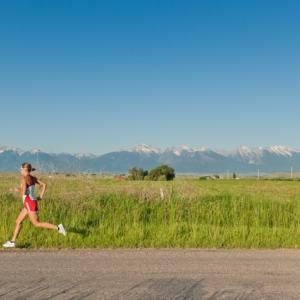
Corbin’s favorite bike rides take her along the Blackfoot River corridor to Ovando or Seeley Lake, or in the opposite direction to the Bitterroot, often to Lolo Pass. Her primary running trails are the Kim Williams Trail, which she runs at least five times weekly, or a long run in the Rattlesnake. “The landscape of Missoula makes me a better athlete,” says Corbin. “Whether it’s hail storms or a real rocky run, it can be a hardcore environment – missing from places such as Seattle or San Diego.”

Corbin works out physically, whether it’s swimming, biking, or running, between five and seven hours a day. Every workout has a purpose. Tuesdays and Thursdays require higher intensity, higher heart-rate exertion, and overall harder efforts. If there is no struggle in her life, then there is no sense of adventure.

Since it is hard for her to log the necessary miles in Missoula in the wintertime, Corbin trains in warmer climates for big chunks of the year. Her vision is to “transcend the boundaries of my sport” and “represent the importance of a sound mind, body, and diet in achieving dreams.”

Her most memorable experience as a professional, she says, is still her initial Ironman, which took place in Coeur d’Alene, Idaho, in 2006. She was fraught with nervous anticipation and the natural anxiety of the unknown.

“My biggest issue before the race was being worried about pain and suffering,” says Corbin. “But I felt great afterwards and that was pleasantly surprising.”

During an Ironman event, Corbin consumes approximately 6,500 calories and generally eats about six meals a day. At the 2006 Ironman Hawaii she shed ten pounds. “The heat and humidity were rough,” says Corbin. “My Montana resiliency and stubbornness paid off.”

Indeed, Big Sky qualities are embedded in Corbin’s sense of identity: She picks up a cowboy hat near the end of each race and crosses the finish line wearing one.

“It is a bit of a tradition for me,” says Corbin. “The cowboy hat is symbolic for the fact that I’m having a lot of fun. When I’m not having fun, I’ll stop racing. As long as I enjoy competing, I’ll keep going.”

At 32, she is fully aware that the mid-30’s are the peak years for female athletes in endurance sports. When her mind and body are in harmony, Corbin is inspired. When inspiration flows, her legs and feet move swifter, her muscles strengthen, and her goals are met with a renewed sense of purpose.

“One of the biggest goals for me is to complete the Ironman in less than nine hours, which I’ve done once. Ultimately, I would like to be world champion at Ironman Hawaii (held October 12, 2013).”

When Your Neighbor is a Grizzly

grizzly bearPeople are going to have to accept the big predators as a cohabitant on a limited landscape, the biologists said in a draft conservation plan released this week by the U.S. Fish and Wildlife Service.  MORE>>>
The Missoulian

MSU's Annual Pow-wow

By Jenna Caplette

Jenna Caplette migrated from California to Montana in the early 1970s, first living on the Crow Indian reservation, then moving to Bozeman where she owned a downtown retail anchor for eighteen years. These days she owns Bozeman BodyTalk & Energetic Healthcare, hosts a monthly movie night, teaches and writes about many topics. 

* * *

The weekend of April 12 and 13th brings the Annual Montana State University American Indian Council Pow Wow. It’s free and open to the public. In fact, visitors are welcomed. 

Pow-wow offers an opportunity to celebrate Montana’s heritage. Since my daughter Rose is half Crow-Indian, the MSU pow-wow has been part of her life since I carried her there in a cradle board.

Basically, a pow-wow is a gathering, a time to meet friends, new people, and to have fun. It’s a celebration of dance and music, of native culture and tradition. Many dances emulate a bird of one kind or another. For instance, traditional Crow-style men dancers emulate the Sage Grouse. In the old days, dances used to be particular by tribe or area, like the Crow Tribe, or the Northern Plains, but now dancers choose the style of dance by what they most enjoy. Their choice, and their way of dancing, express who they are. 

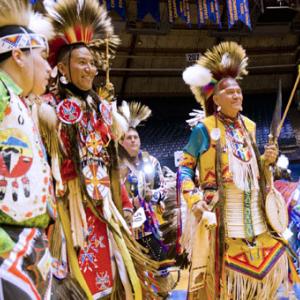
When you watch a pow-wow, notice the different styles of outfits. The easiest to pick out might be women’s jingle dress dancers, outfits covered with metal cones. Plains traditional dancers usually wear buckskin outfits. Crow traditional dancers often wear wool dresses decorated with real or imitation elk-teeth. If a woman is carrying a shawl and wearing a dress decorated with ribbon, she’s probably a fancy dancer.  The shawl is a piece of art by itself.

Some dancers are professionals who travel the pow-wow circuit competing for prize money. They will participate in contest dances, working to get points, to demonstrate their skill. Judges watch them for their participation in the inter-tribal dances as well.

When the announcer calls an inter-tribal, everyone dances, mixing styles of dancing together. It is during an inter-tribal that visitors can participate. First watch for awhile to get the feel for how to dance.  It’s not at all like the dancing from old time Hollywood movies. Then, before you join in, you may want to check in with the arena director or assistants and ask if it’s a good time to do so.

If you want to take photographs, the Grand Entry event, held each night at 6 PM, offers a spectacular photographic opportunity. If you want to photograph a particular dancer, ask the person politely to take their picture. As with any other group of people, some don’t want their picture taken, some won’t mind.

This year’s host drum is “Young Spirit” and there is a contest for best drum group. Rose’s dad is a pow-wow singer. She says. “It makes my dad happy to sing from his heart. He has a passion for pow-wow music.”

When she was small, she used to sit on his lap and drum with him. For her,  “Pow-wow is being the rhythm, the beat of the drums. You dance and you can feel it in your feet and you dance and you’re so proud of yourself.”

We take our best shawls, get ready for the inter-tribal.