The Apple and the Architect: Frank Lloyd Wright's Montana
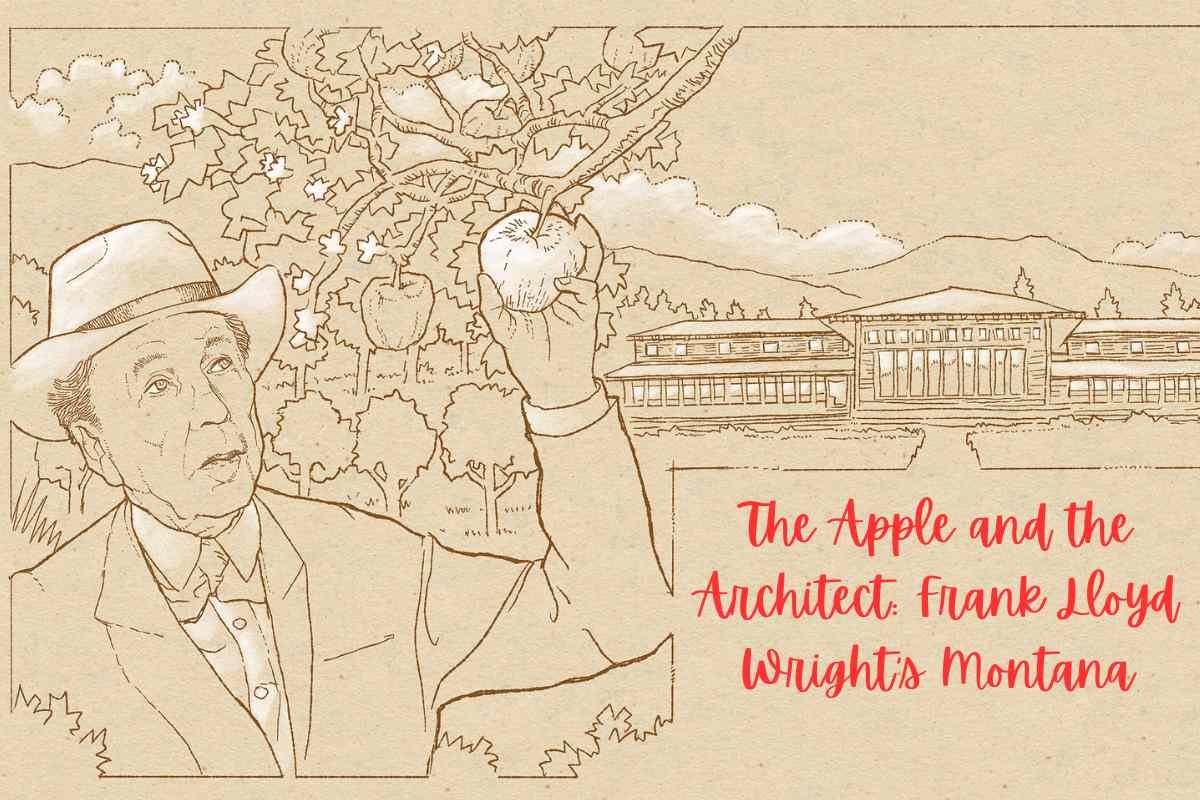
In a moment of almost biblical resonance, Father De Smet planted the first apple trees in the Bitter Root Valley and, indeed, in Montana, in the late 1840s. The Mcintosh, a hardy variety tamed from wild apple trees found in Canada in the 18th century, would eventually thrive there, its sweet and juicy flavor accentuated by Montana's early autumn frosts. The Bitter Root filled, gradually, and finally almost alarmingly, with apple trees. By 1900, there were nearly 300,000 apple trees in the area. The fruit born thereof would spawn an investment bubble that swelled to inordinate size. It was almost precisely at the height of that bubble when the Bitter Root Valley Irrigation Company hired forty-two-year-old Frank Lloyd Wright, then considered one of the finest architects in the nation, to design certain projects in Montana.
The money men behind the BRVI were a trio of Chicago financiers—W.L. Moody, L. Burns, and Frederick D. Nichols—along with Samuel Dinsmore, a local land developer who was attempting to complete the legendary copper baron Marcus Daly's vision of one day irrigating the benchlands of the Bitterroot and Sapphire Mountains. In service of that dream, the BRVI constructed the Big Ditch, an irrigation network spanning some 80 miles and running from Lake Como up the benches, largely parallel with the Bitterroot River, between 1908 and 1910. Naturally, these being men who understood the making of money, the scope of the project widened to include elements not strictly of a fruit-related nature. Como Orchard was conceived of as something like a combination time-share resort and communal farm—10-acre lots were to be sold at $400 an acre to the right sort of people, largely Chicago professors and intellectuals, who would visit in the summers and eventually make 10% of the profit raised by the BRVI off of their parcels. If everything went well, each investor would earn passive income from their rugged, and decidedly architecturally pleasing, getaway spots.
Wright was not yet the household name he would become. Those who did know him, largely avant-garde architectural circles, knew him as the author of the Prairie School—organic architecture emphasizing natural materials, earth tones, and flat horizontal lines that recalled the plains of his native Midwest. It was the first indigenous American architectural movement in a field dominated by European revivals. The middle-aged architect had, therefore, already made a name for himself in architectural circles for the Darwin D. Martin house in Buffalo and the Edwin H. Cheney house in Oak Park, and the Larkin Administration Building, also in Buffalo. The Frederick C. Robie house in Chicago, one of the most beautiful examples of his Prairie Style, had only been completed the year before, in 1908.
In his autobiography, written some twenty years later, Wright described 1909 as a year of exhaustion and crisis. Exiting a period of great creativity and productivity, he found himself suddenly tired all the time. "Every day of every week and far into the night of nearly every day, Sunday included, I had 'added tired to tired and added it again and yet again...'" he wrote. Wright had been married to Catherine Lee Tobin for twenty years, and they had six children together. They had met while attending a church social. He called her Kitty. They courted for two years before marrying in 1889. She was a June bride. He would remember her as a "mass of red curls, rather short, bobbing in the breeze. White skin Cheeks rosy, Blue-eyed, frank and impulsive. Generous to see and to me." In the course of their courtship, he says, "With no knowledge at all we had come to the boy and girl intimacy, no longer satisfied with sheepish looks and perfunctory visiting or playing or talk or music." Wright had wished to feel free to explore that euphemistic "boy and girl intimacy," but had found it hard to do so under the prying eyes of their relations. The solution was to propose. After all, he wrote, "Freedom is necessary to any beauty in any fellowship." They married, he twenty-one, she eighteen, and embarked on life. He built their first house.
But by his year of exhaustion, freedom had begun to take another shape for Wright. "I could see no way out," he wrote. "Because I did not know what I wanted I wanted to go away... A true home is the ideal of man, and yet-well, to gain freedom I asked for a divorce." And too it meant being able to run away with Martha Bouton "Mamah" Borthwick, the wife of one of his clients. Wright asked his wife for a divorce and was told that if he waited a year, it would be granted.
Meanwhile, in early 1909, the BRVI approached Wright to be their architect on the Como Orchards Project. By February he visited the site of the orchards. There was likely snow on the ground, and the weather was chilly enough to make it hard to imagine a flourishing resort and orchard complex, but still he worked, adding tired to tired. Eventually, the scope of the BRVI's plans expanded, and Wright was tasked with designing the planned town of Bitter Root, Montana. The town, developers insisted, would someday soon rival or exceed Missoula in population and popularity. Montana's Bitter Root Mcintoshes would become the principal agricultural product of the valley and the center of its social and cultural life. Ambitious as ever, perhaps buoyed by the persistent boosting of the land developers, Wright submitted an almost fantastical design with 54 constructions ranging from civic buildings like an opera house, museum, theater, and office blocks to residences, united by streets, walkways, and a de-pressed rail line. The Bitter Root Inn, a hotel, would lie just east.
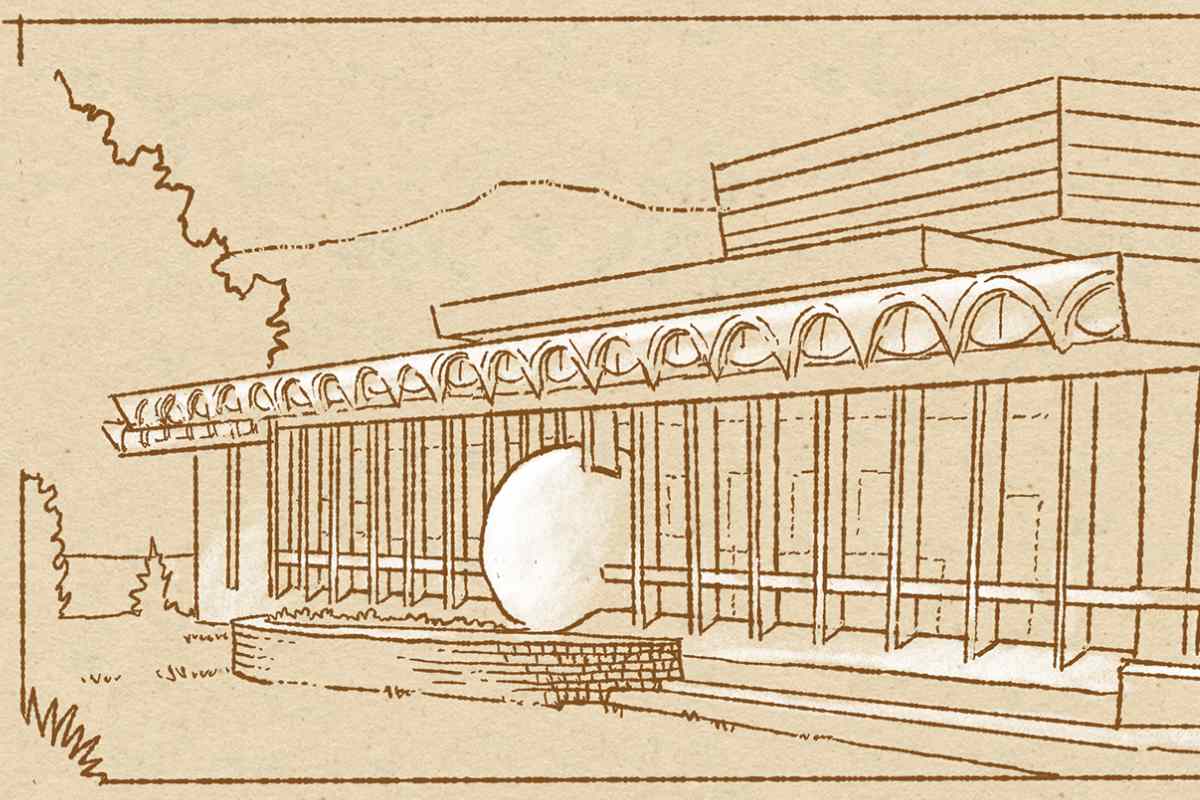
The Lockridge Clinic as it would have appeared in the 1950s. It was one of Frank Lloyd Wright's final buildings.
Meanwhile, he tried to engage in the pursuits that brought him peace: reading, listening to music, riding his black horse Kano (named for a school of Japanese painting) through the prairie. He turned, in desperation, to driving his motorcar around the roads, though, he wrote, the automobile "brought disturbance of all values, subtle or obvious, and it brought disturbance to me." In his autobiography, he outlined, in detail, a three-part philosophical proof that rationalized for the reader, and perhaps for himself, his blamelessness: "First Legal marriage is but a civil contract between a man and woman to share property and together provide for children that may spring from that marriage. So, in this respect legal marriage is subject to the legal interpretations and enforcements of any other contract. But legal marriage should be regarded as no mere license for sexual relation." Second and Third proceeded logically therefrom.
The promised year passed. When Catherine still refused the divorce the situation reached its head: "So, turning my clients' plans and draughtsmen over to a man whom I had but just met, a young Chicago architect, Von Holst, and making the best provision I could make for my family for one year, I broke with all family connections..." He made for Europe on a first class luxury liner with Mamah Borthwick. He left his wife and six children behind; she her husband and two children, John, 7, and Martha, 3. Wright's son David would much later recall how his father had left his family with an unpaid grocery bill for $900.
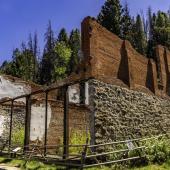
In Montana, work had been completed on the Como Orchard Clubhouse by March of 1910, and as Wright and Borthwick sought their freedom, the future of the apple industry in the Bitter Root Valley seemed as solidly secure as the mountains in whose shade they grew. Only a handful of the Como Orchards Project buildings were actually built: the Clubhouse and twelve other cabins of either two or three bedrooms. Various deterrents conspired to squelch the unborn apple empire. The failure of the Chicago intellectuals and professors to precipitate, and the unpredictability and fitful inclemency of Montana weather were among them. A 1913 blight marked the beginning of the end of apple speculation in the valley. The BVRI declared bankruptcy in 1916.
The failure of the Como Summer Colony and the Como Orchard may have haunted Wright. It receives only one mention in his autobiography: "Some one hundred and seventy-nine buildings, as this is written both large and small-had been built from my own hand by now and are known as this work of mine. About seventy more, the best ones, had life only on paper. The most interesting and vital stories might belong to those children of imagination were they ever to encounter the field." The planned town in the Bitter Root is mentioned in this context-as an unfinished project that is as interesting, as ambitious as any-thing he actually saw built, and perhaps, as full of pathos.
"Wright may have lost the Como Orchard commission before he left for Europe," writes Wright expert Randall Lecocq. The "un-completed Montana utopia" represented a large investment for Wright, who had possibly put some of his scanty capital, plus untold hours of time and thought, into the venture. Historians might be able to discover more about Wright's exact role in the BVRI's plan, whether he was an architect on contract, or had been fired; whether he had spent his own money, or whether the BVRI consulted with Wright's representatives during construction, were it not for the loss of an enormous amount of documentation in a 1914 mass murder and fire that would claim the lives of seven people, including Borthwick and her two children.
Borthwick and Wright had moved back to America in 1911, and built Taliesin as a refuge from scandal and society. On an August afternoon in 1914, Julian Carlton, a servant employed at the home, killed seven of the nine people there, including Borth-wick and her two children, John and Martha. Carlton set fire to the house after the murders. Wright had Borthwick buried in an unmarked grave on the property. After all, he had built it for her.
In 1923, the Como Orchards closed for good. They were purchased and renamed the Montrose-Morello Orchards. The Clubhouse, no longer needed for its intended purpose, was whitewashed and redesigned as a space for orchard workers. The Montrose-Morello Orchards also failed. Two years after that, only eleven years after it burned down the first time, the reconstructed Taliesin burned down again, this time when lightning struck the house during a storm, causing a surge.
By the 1930s, Wright had abandoned the Prairie School for a newer, more streamlined style he considered the "architecture of American democracy," Usoniasm, which employed standard-ized materials and built-in furniture to reduce costs and in so doing make it affordable for the average American. As the 1950s, and Wright's tenth decade on Earth, began, Usoniasm began to appropriate almost space-age components, like the enormous white plastic sphere planter outside of the Lock-ridge Medical Clinic in Whitefish, Montana. He designed it in the year before his death. The Whitefish Pilot reported on Friday, July 10, 1959 on the fascinating building: "The new clinic building on Central Avenue by the famed architect, the late Frank Lloyd Wright, to house the offices of Drs. Lockridge, Whalen and Mcintyre, is one of three western projects by Wright considered in an article in the June issue of the Pacific Architect and Builder. The Whitefish building, the article notes, is the only Wright-designed one in Montana, and states that the architect had planned to visit the building, since his desire to have a structure in the Montana mountains was one reason he had designed it."
What can we make of the article's insistence that it was the only Wright-designed project in Montana? Could a man in his nineties, a man now considered the finest architect of his times, still rue an exhausting year spent poring over plans for a utopian town that would never come to exist and yearning for the freedom to leave his family? Or did he assume that none of his Montana buildings still stood, and really did long to have a structure in the Montana mountains? Needless to say, Wright didn't visit the building. He did not survive to see any of his Montana projects completed. Yet completed it was, if a few years after the architect's death. It had a horizontally oriented floor plan with orange-tan bricks, 64-feet of floor-to-ceiling windows, a fireplace in the lobby, and a trim of Philippine mahogany painted Cherokee red, Wright's favorite color. There was a planter on its rooftop and a reception desk de-signed to be as unobtrusive as possible so as to support the illusion that patients were in someone's (elegantly designed) home. The most striking design element, according to author and founder of the Frank Lloyd Wright Quarterly Dixie Legler, "appears to be without precedent in Wright's work: a seven-foot-diameter plastic sphere poised in the center of the glass wall facing the garden. Half inside and half outside the glass wall, this voluptuous white orb was...lit from below by floodlights," a "glowing translucent bubble."
In January of 1960, the clinic opened with a party to which the public was invited. Hundreds attended. There appears to have been some minor controversy over the design of the clinic, but the Pilot weighed in via an editorial: "Now that it is in use, and everyone has had a chance to inspect it, we would like to publicly hail the new Frank Lloyd Wright clinic building and those responsible for its construction in Whitefish ...If the people who put up this building had listened to a handful of gloom merchants, Whitefish wouldn't have its new clinic. Fortunately, these people chose instead to look around them and find the potential for Whitefish which we at the PILOT and many other people in other businesses also believe in. That is the value of the positive approach. And that is why we salute the new clinic."
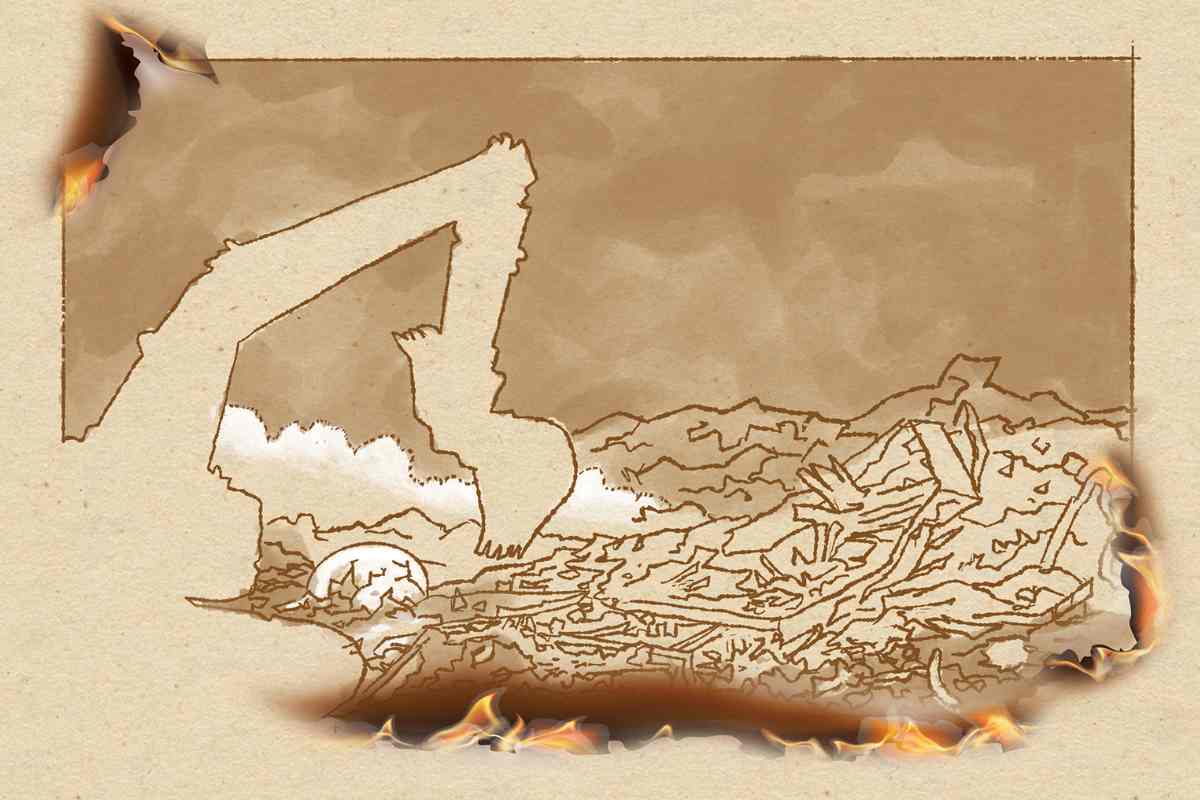
The clinic was succeeded by the First State Bank, which made alterations to the original design, after which it housed a series of professional offices from the '80s through the 2000s. In the 2000s, the Morris and Frampton law firm bought the building and helped to restore it to something like its original form. In 2016, developer Mick Ruis purchased the former Lockridge building. He later claimed that he was unaware that it was a Wright building. He began planning to demolish the building in 2018, as various preservation groups scrambled to prevent its destruction. The Frank Lloyd Wright Building Conservancy offered Ruis $1.7 million to buy the building from him. The next day, Ruis replied that he would need a 50% deposit on the property by 5 p.m. or demolition would continue. The funds necessary to pay the ransom could not be raised in that short time. That night, while preservationists scrambled and lawyers consulted, Ruis exercised his property rights. By morning, the Lockridge Clinic, one of Wright's final works, was gone.
It was the first time in four decades that a Wright building had been demolished. It fell, not with a fire, as did Taliesin in 1914, or with a disastrous blight, as did the Como Orchard Project, with the investors left holding worthless land, or with a freak lightning strike and faulty wiring. Rather, it fell by right of property, at the behest of land developers who felt free to erect a strip mall in its place. Now, those passing over that ground have no inkling of its connection to a national architectural movement that has itself vanished and been replaced. Two of Wright's buildings are still here in Montana, part of the Alpine Meadows Ranch near Darby, where they have become a luxury vacation rental listed on the site Third Home Exchange, where members post and swap their properties. In the listing, the present owners say, "By staying here, you will not only enjoy a secluded, nature-filled getaway, but will also help us restore our organic apple orchard and the over 200 acre grazing project to heal our soil and revive FLW's full vision of a working apple farm." Wright's utopian community of Chicago professors, each making passive income from their ten-acre parcels, never materialized. But the buildings remain, offering what they were always meant to offer: escape, beauty, and a particular vision of freedom in Montana-for those who can afford a bite of the apple.
Demolished in one night. One fewer Frank Lloyd Wright building remains.
Listen to this episode on our podcast, Distinctly Montana Stories:
Enjoyed this story?
Montana has more layers than most people ever see.
Distinctly Montana finds them, four times a year. Subscribe and get every issue.
There is also a Frank L Wright house on south 3rd Street in Hamilton... My father always said it was for sale in the 1930's for $3000, and no one could buy it..





























- Reply
Permalink