Preparing Not to Fail
by Doug Stevens, “The Graytrekker”
My main outdoor focus is being an avid backpacker and backcountry landscape photographer. Even though I do get out and do things in the winter, like skiing, etc., late Spring through Fall is my favorite time. Therefore, I find I spend a lot of time in the winter planning and preparing for the seasons ahead. Before retiring, it was important to have a plan for my time off work to maximize my opportunities to get out. While I no longer have that schedule to consider, going into late Spring with a plan is just as important.
Over the years, I have learned that there are a lot of variables that go into a successful trip and a successful backpacking season. For example, knowing what kind of snowpack we have can affect when you can get into certain places in the high country – should I plan on July or August? It can also be a predictor of possible fire season. I have had several well-planned trips severely impacted by smoke from summer wildfires, such as in Glacier National Park from the Howe Ridge fire in 2018 [http://www.distinctlymontana.com/node/40298].
You can monitor the snowpack and precipitation through the USDA Natural Resources Conservation Service (NRCS) web site for Montana, or any other state for that matter [https://www.nrcs.usda.gov/wps/portal/nrcs/mt/sno/]. This site not only gives area snowpack on a “basin” level, but there are also web sites for individual backcountry electronic monitoring stations, known as “snotels”. I keep an eye on these sites throughout late Winter and early Spring and have back-up trips planned to other areas in case my first choices are negatively impacted by too much or too little snow. As with investing, diversity is important.
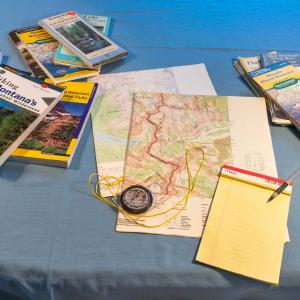
Then there is the matter of just where to go. I have been to several places in Montana that were simply stunning and I would love to return, but at the same time, I would like to also explore new ones, so I shoot for a balance – some old, some new. I spend time in January and February pawing through hiking books of various places, such as, the Bob Marshall Wilderness, Beartooths and Glacier National Park to get an idea of where to go. Anyone who has taken any time looking through bookshelves at places like local REI stores or Barnes and Noble will recognize the yellow color of the Falcon Guides – probably the most ubiquitous of all hiking books in Montana (and other western states, as well) [http://falcon.com/].
What trip planning is complete without a good set of maps? I know some people are more comfortable with a GPS, but I never go anywhere without a compass and map – you never have to worry about the battery. There are many sources for maps. There are the “old fashioned” USGA 7.5 minute quadrangle topo maps [https://www.usgs.gov/products/maps/topo-maps] and each national forest publishes maps of their forest [https://www.fs.usda.gov/visit/maps]. These latter are particularly useful for navigating the back roads in the national forests to get to trailheads. Lately, new companies have been offering maps, such as Beartooth Publishing [https://www.beartoothpublishing.com/]. and National Geographic publishes trail maps, as well [https://www.natgeomaps.com/trail-maps]. These are great maps and, unlike USGA topo maps, they are printed on waterproof paper. National Geographic also offers USGS topo maps for free pdf download, so you could print your own maps. [https://www.natgeomaps.com/trail-maps/pdf-quads]. Finally, I like to check out various backpacking YouTubers, just to get an idea of the scenery they pass through in their videos.
Another thing I always check is whether an area is dog-friendly. Obviously, dogs are not allowed in the national parks backcountry, but some wilderness areas can be “leash only” or no leash. I have a four-legged trail companion, and it debatable whether she likes coming on my trips more than I enjoy having her company. Therefore, I always put in the research to find out the applicable dog regulations so she can come with me.
Finally, there is being in shape to successfully complete the planned trips. I can certainly attest, every year gets a bit harder, so its important for me to have a training plan. With the mild winter, we have had this year, there hasn’t been the skiing and other activities I usually do. However, it may mean being able to get on the trails earlier and put in as many miles as I can with a training pack, for my dog and I. Not only does she need training, too, but its important that dogs be conditioned to long walks on rocky terrain by building up the thickness of their pads. Often the softer surfaces over winter result in her losing some of this, leaving her possibly at risk for foot injury. We don’t want cut paws in the backcountry, though I do carry the necessary first aid for her as well as myself.
To sum up, a successful, fulfilling backcountry season requires a certain level of planning and preparation. It's important to take to heart the popular adage often attributed to Benjamin Franklin: “By failing to prepare, you are preparing to fail”. Personally, I use this time to be sure I am preparing NOT to fail.
Happy Trails!
graytrekker@gmail.com