 Brian D'Ambrosio is a writer/editor living in Missoula, Montana. D'Ambrosio is the author of more than 300 articles and five books related to Montana history, people, and travel.
*****************
Lost wax casting. Synclastic raising. Anticlasting raising. Hollow construction. Haddon Hufford speaks the vernacular of the silversmith with a lexicon centuries old. Common terms: annealing, engraving, chasing, planishing, polishing, raising, repoussage, sinking and soldering.
Spend a few hours with Hufford in his quiet, rustic Frenchtown home and studio and his encyclopedic knowledge of the craft makes you feel badly uninstructed. With a rough-hewn scholarliness, Hufford explains that ‘annealing’ is when metal is heated for altering. ‘Planishing’ is the act of using a highly polished hammering to refine metal surfaces. ‘Raising’ shapes a hollow form in the metal.
Hufford is the consummate teacher, sharing definitions and histories with thoughtful regularity. One minute he could be discussing the colonial artistry of Paul Revere, and his “first copper rolling mill”. The next, he describes how to imprint and texture a design into metal. From there, there is talk of sinking (hammering the metal to create a concave hemispherical shape), and soldering (connecting metal with a low temperature heat). Hufford’s sentences are not haphazard slivers of verbiage, but more like authoritative pronouncements.
“Silversmithing in many ways is the forcing of metal into new directions, directions it may not wish to go,” says Hufford. Looking at Hufford’s work, you glimpse silversmithing’s ancient endearment, intense difficulty, and unique beauty in a single handsome piece. On one table stands a pair of sterling silver candlesticks, with a long tapered, hammered stem, and a spiked candle holder. Contemporary candelabras, its finish both hammered and polished, with a ball and jutting arms for tapered candles. Hufford’s craftsmanship articulates the flurry and force of a man who pays stout attention to details.
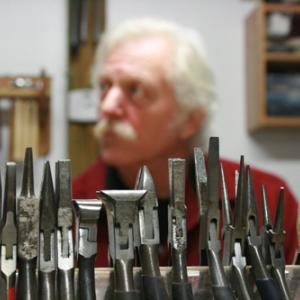
Many of the tools used in ancient times are still used by modern silversmiths. Ancient tools Hufford finds familiar include tongs, hammer, anvil, engraving burins, small mallets, large scales, weights, and blow pipes. Hufford’s studio walls are lined and stacked with dozens of different shaped hammers and mallets, each with its own distinct impression. Also displayed in his shop are specialized hammers, anvils, and metal working stakes, many of which are hand-made.
Tools alone are simply tools. It’s the craftsman who breathes creative life into them, who understands their purpose, perpetuates their methods. There is something revelatory in seeing the two together, an almost Pentecostal feeling of seeing in tongues. Hufford says that each hammer’s shape and style leaves its own distinction. Mental conditioning is important, too. Metal moves at such a leisurely pace; hammers slowly form their outcome.
Arms tire and the mind needs to be attentive to the body’s needs. It is written that sometime in the Middle Ages a rift between goldsmith and silversmith took place. Silver was plentiful, less costly than gold. Individuals starting out could not afford gold as their working medium. Goldsmiths became highly revered. They often served as the local banker, whereas the silversmith took the goldsmith’s training and began a new trade commodity.
Hufford’s art is the continuance of that split. Hufford has lived in the woodsy hills of Missoula Valley since 2006. He was born and raised in New York's Hudson River Valley, studied graphic design at Parsons School of Design in Manhattan, before serving in Vietnam as a combat cameraman in the Army's 1st Air Cavalry Division, from 1969-71. Hufford then trotted the globe in the subsequent twenty-eight years, working in the film industry as a dolly and crane grip and set builder (he worked on at least 75 films).
His journey into metalsmithing began serendipitously on a trip through Argentina in 1996. In a tiny village on the Pampas, Hufford visited a silversmith's workshop and become fascinated. Wonder is a measure of what this world is all about. In that South American shop, Hufford learned that wonder could be an antidote to the chaos of the world.
“There were three silversmiths in town,” says Hufford. “One of them invited me in to his studio. It was a powerful and exciting exhibition. I came home and I got started.” Sterling is his material of choice because of its inherent beauty and value; it requires Zen-like endurance forming and forging noble metal. Hufford says, "I know that the blow from the smith's hammer is directly related to the heart beat and rhythm of life itself.
There are times in the solitude of my studio when hand and hammer become one and the repetition of the overlapping blows brings me to the point of meditation."
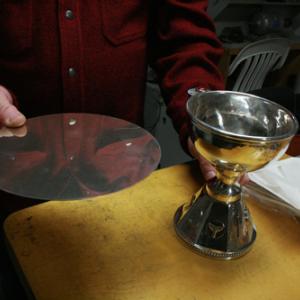
Techniques used to join silver together include welding, soldering and brazing. Hufford’s silversmithing incorporates the skills he obtained in the workshops and homes of craftsmen across the world, an Irish metalsmith, a Bulgarian silversmith, a New York jeweler. A desire to follow an abiding sense of curiosity opened up an entire new world of shape, form, and creation. Some of his forms are common finely metal-smithed forms: letter openers, candelabras, goblets, and vessels. Each hand-wrought piece that Hufford forms is original, masculine, and ordinarily geometric, and he is proud to have not once duplicated an object.
All of Hufford's work is either created on commission or sent to Lauren Stanley American Silver gallery in New York City. No matter where they go from there, they will remain fragments of Hufford’s experience, accounts of his spiritual and artistic growth.
Silversmithing, like life, allows for the possibilities of transformation, a daily opportunity for Hufford to experience the vigor of the everyday. Its enduring link to man’s innate desire to shape and create something eye-catching isn’t lost on Hufford. “Silversmithing goes in and out of vogue,” says Hufford. “But I think that silver has, and always will, connect to people. Think about it, candlelight, a glass of wine, a great dinner, and silver, hand-wrought candleholders. That says it all.”







 People are going to have to accept the big predators as a cohabitant on a limited landscape, the biologists said in a draft conservation plan released this week by the U.S. Fish and Wildlife Service. MORE>>>