One Handshake at a Time: JFK's Courtship of Montana
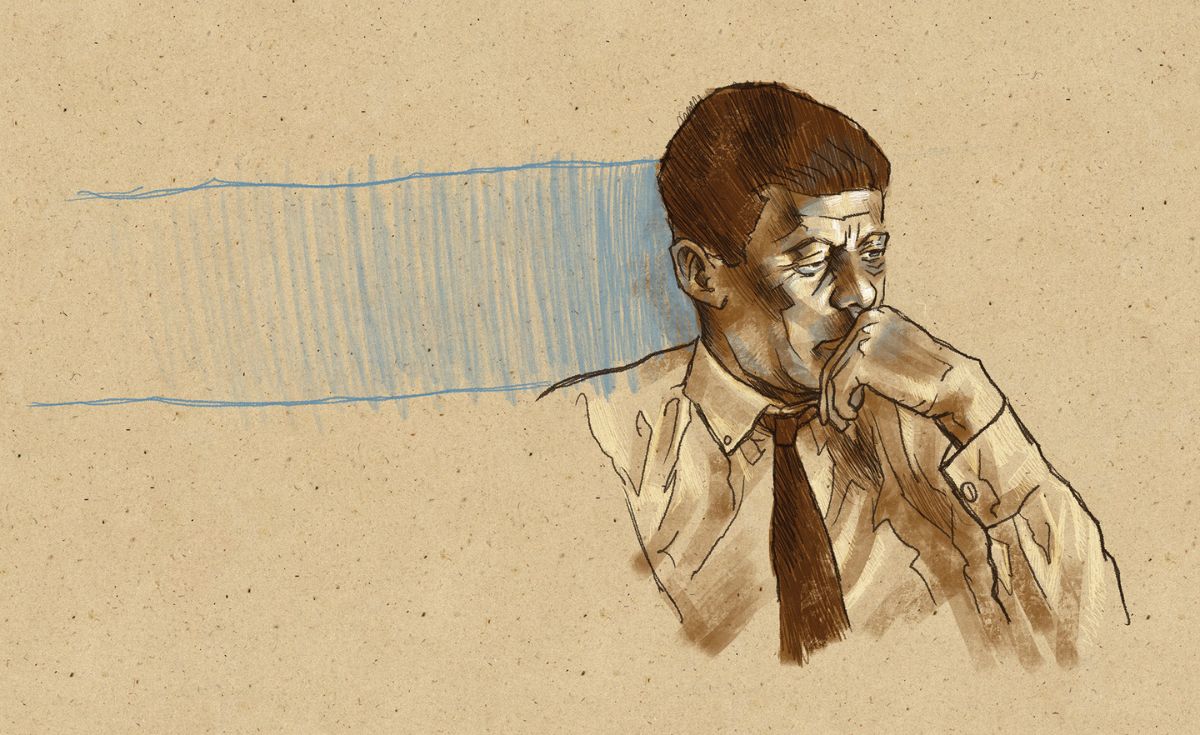
John Fitzgerald Kennedy faced a difficult task in Montana.
The state voted Republican. Kennedy was wealthy, from a powerful New England family, and carried an aura of glamor—all the wrong credentials for winning over ranchers and miners. He was good-looking, yes, and young, but he wasn't exactly a cowboy. Even among Montana's Democrats, he seemed a long shot.
The state's Senators, Mike Mansfield and James E. Murray, backed Lyndon Johnson for the 1960 nomination. Montana Secretary of State Frank Murray favored Stuart Symington. Others wanted Adlai Stevenson. Montana had already denied Kennedy the votes for Vice President in 1956. He faced an uphill battle. It was a state he could never hope to win, and yet its people could just maybe be won over, one handshake at a time.
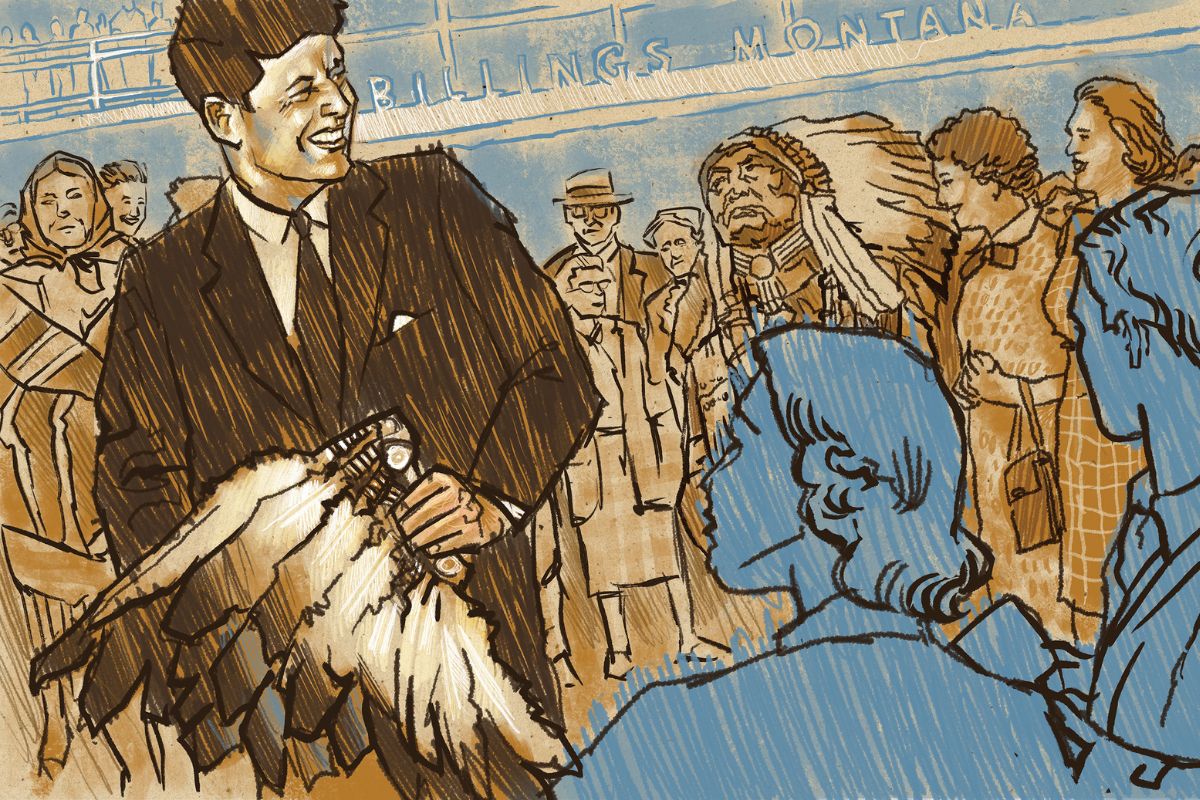
Kennedy's courtship of Montana began modestly when he stepped off his plane in Billings in 1958. It was a warm and sunny Father's Day, and the Senator from Massachusetts arrived to no great fanfare: there was a crowd assembled to greet him, but it was hard to tell how many of them were there to see him and how many just happened to be attending the concurrent dedication of the new Airport Administration building and decided to see the young politician off his plane, too, while they were at it.
Definitely there for him were two "hospitality queens" from the Chamber of Commerce and seven representatives of the Crow tribe, who presented him with a pair of cuff links and a ceremonial headdress: JFK accepted them both, all smiles. Then, seven Crow natives named Kennedy "Chief Curley" of the "family of Strong Eagle."
He held the headdress but didn't put it on. The reception may have been enthusiastic or muted: journalist Edmund Christopherson called it "typical."
His electioneering strategy revealed itself at the evening's fundraising dinner in the basement of the Al Bedoo Shrine. There had been some debate about the pricing of the evening's festivities. Should it be higher, and cater to the more affluent donors? Or should the price be lower, encouraging wider attendance? Kennedy argued for the lower price, and his camp prevailed—the cost would be $3.00 a plate.
Some wrangling had preceded the Sunday evening dinner. Late on Saturday night, a rancher named Clem Cormier received a call from someone on the Crow Tribal Council, whom Cormier had previously arranged to come to Billings and make Kennedy an honorary member of the tribe. They demanded that Cormier pay them $800 up front or they wouldn't attend. Cormier balked. Instead, he drove to Hardin, bought the headdress presented to JFK at a gift shop for $65, and convinced his friend, the Crow rancher Fred Strong Enemy, and his family to attend instead. It was they who inducted Kennedy into the tribe. Cormier would also present JFK with a cowboy hat and boots, which he likewise declined to put on, but held politely in his hands.
At the dinner, Kennedy spoke about his policy on farmers and the perceived failure of his opponents—including Vice President Richard Nixon, his likely opponent in the 1960 Presidential election, should he secure his party's nomination. He admonished the Eisenhower administration's decision to block the Yellowstone Dam, saying that we needed to develop more dams in order to keep up with the Russians, who were set to exceed American production of hydroelectricity "by 1975." He finished by quoting Robert Frost: he had "promises to keep" and "miles" to go before he could sleep. At the end, Kennedy shook hands with all 700 attendants—many more than the expected 400.
Kennedy was denied the pleasure of waking up in Montana on that first trip. His busy schedule demanded that he get on a plane that very night.
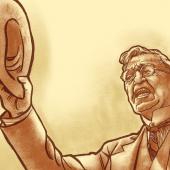
While driving to the airport, Nick Maltese, the county chairman who had arranged the dinner, asked him why he hadn't worn the headdress for the crowd. He replied that he remembered Calvin Coolidge photographed in one of those getups before and didn't care for the association.
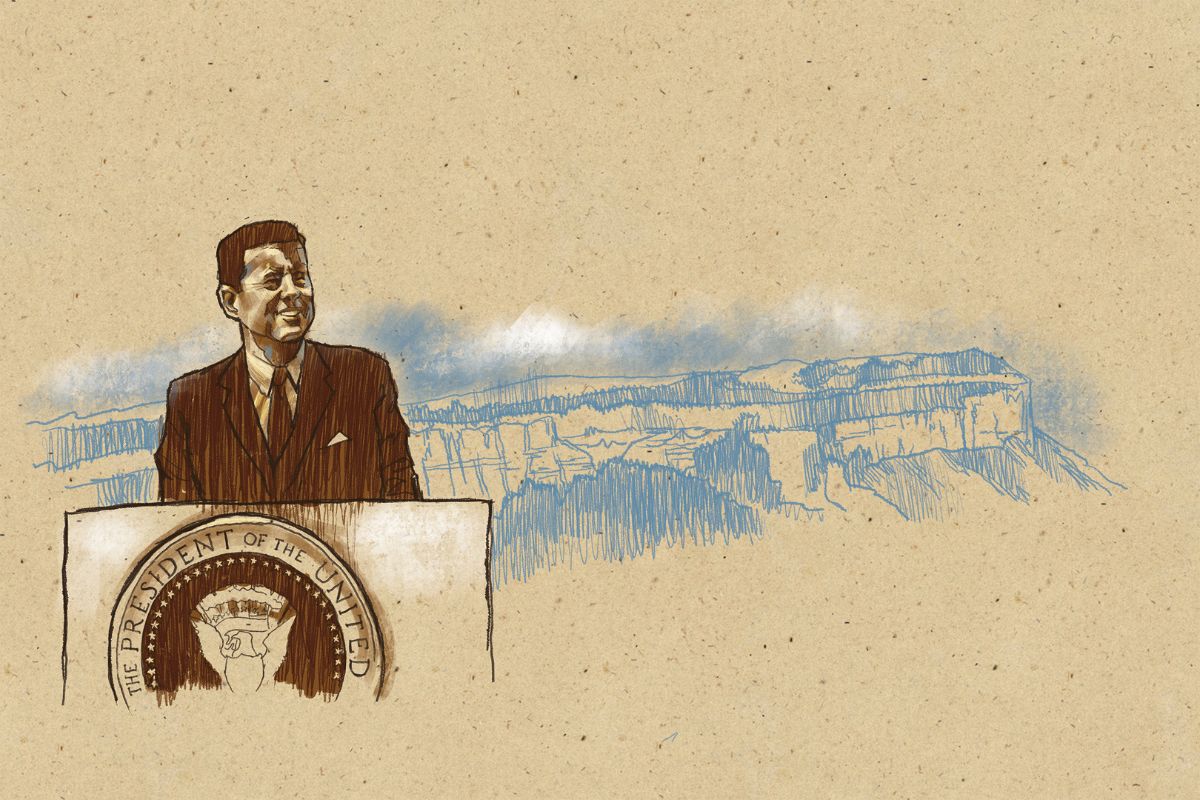
Even so, Kennedy seemed to take some pride in his "official" Crow status. He wrote Red Welsh, one of the organizers of his first visit to Montana, and greeted him with "How, Kemo Sabay." And later, on Jack Paar's television show, he joked that now that he'd been accepted in the tribe, he would start rooting for the Indians in Westerns.
He returned in March of 1959, this time to Butte. Once again, it was a speaking engagement and he wouldn't be spending the night. Speaking to a crowd of 400 (impressive as there was only three days' notice to arrange the event), Kennedy flattered the crowd. In a radio interview that afternoon, he had called Butte the "Boston of the West," and added that "Boston is sometimes called the Butte of the East."
To a town with considerable roots among the so-called "shanty Irish," he must have seemed to some like the epitome of the "lace curtain Irish"—well-heeled and respectable. His wife, wrote Christopherson, though "attractive and gracious," was possibly hindered by "her bouffant hair style and eye makeup that hadn't yet caught on out here," and by what some found to be an "aloof, modern... Eastern reserve—almost a coldness" quite unlike the "easygoing, informal" Westerners around her. It was to be Jackie's only trip to Montana.
Still, he won many supporters in Butte for having chosen to speak with the student journalists from the local high schools first thing after arriving. Joseph Duffy was one of the students he met with, and he would remember later how he had been "very impressed by his interest in us—to suddenly be in a discussion with a man who, in retrospect, seems to have been every bit as great then as now, is something that stays with you a long time."
Kevin and Joan Shannon, meanwhile, spent the day at home, relaxing. They had asked if Senator Kennedy might be available to discuss their charitable organization, the Rocky Mountain Association for Retarded Children, with them—it was an issue near to their hearts, as their own child suffered from developmental disabilities. Kennedy hadn't responded yet, and as it was late in the day, they must have figured their request fell on deaf ears by the time they received a phone call.
"Yes, hello?"
It was JFK's aide Dave Powers. He asked them if they had the time to meet with him.
Thinking it might be a prank, Kevin threw a coat over his simple wool shirt and he and Joan drove to the Finlen Hotel. Powers intercepted them as they entered. He looked at Kevin Shannon, smiled, and said, "Your face is a map of Ireland, could you be Kevin Shannon?"
Kennedy spent a long time talking to the Shannons—long enough that he arrived a little late to his fundraiser dinner. He told them that his own sister, Rosemary, suffered from a similar ailment. They found, to their amazement, that a nun who had been caring for Rosemary now taught at the local School of the Immaculate Conception.
When they paused for a photo opportunity, Kennedy, noticing that Joan was pregnant, said, "I think that Mrs. Shannon would be more comfortable if she kept her coat on." This small act of grace may have saved her some embarrassment. Later, Kevin would remember thinking the future presidential candidate "looked 20 feet tall. We were starry-eyed. It was like a dream. A man who could be president, yet he took time to sit down and talk to us about our problems. They couldn't have been nicer. We thought, 'who are we to take his time?'"
At the dinner, he continued his wooing of the Buttians at large by welcoming "the Irish and all those who would like to be Irish." The two groups composed a considerable portion of the population of Butte. As Kevin Shannon reported, "That day I was proud to be Irish!"
Kennedy won primaries in Wisconsin, West Virginia, and Oregon. The nomination was in reach, but Montana's delegates wouldn't vote until late June. They would have to be won over.
JFK and his entourage arrived at Helena on June 26 at 11 p.m. He disembarked from his plane and took a call. Symington, his rival, was already at Boulder's Diamond Bar S, where he was supposed to stay. Despite being exhausted, Kennedy decided to stop by the less luxurious Placer Hotel and meet the delegates. He entered carrying a suit on a hook. One onlooker would remark that he "never saw such a tired man in my life." Another, Leo C. Graybill Jr., said that the weariness couldn't dim him: "He still gave that feeling of personal intensity—a real jolt—when he looked at you with his tremendous blue eyes and shook your hand—a feeling that he was concentrating on you..."
However tired he was, Kennedy decided to spend nearly the whole night at the Placer taking meetings and making phone calls. Journalists and entourage were everywhere, stealing a few moments of sleep wherever they could, on couches or on the floor. Kennedy finally sent down to the front desk for a board. He needed one for his bed, as a consequence of a bad back. Marie Merrill, secretary of the "JFK-For-President" organization in Helena, retrieved a length of plywood from a banquet table and delivered it to him.
The next morning Kennedy and his people were up at 6 a.m. in a moment captured in Theodore White's classic The Making of the President, 1960:
"Outside, the mountains of Montana were fragrant with early summer, pine and fir glistened as they reached to the sky on a June day of absolute purity, the dandelions had passed to seed, but the mountain slopes twinkled with daisies, with primroses, with bluebells, with black-eyed Susans, with purple lupine. But Kennedy had indoor work to do..."
Indeed, JFK was up and moving about in a blue nightshirt by the time people started to arrive. They ate ham and eggs and discussed the delicate delegate situation. Kennedy shaved in the bathroom of room 620, wearing a blue towel and answering questions as he lathered. Then he crossed through room 621 into 622, where he took a shower. He returned through the adjoining rooms to find that more and more people were arriving, including four women. "Whoops," Christopherson has Kennedy tell his audience. "I didn't know so many people got up this early in Helena!" He excused himself and went back to 620. There he dressed, and emerged with a pair of wet socks he had washed in the sink and asked Marie Merrill where he could hang them.
They took meetings all day. Eventually, Kennedy got hungry. Wally Wong, the owner of House of Wong, was phoned and asked if he could arrange an off-the-menu request: Senator Kennedy would like some cream soup. Wong indicated he would provide it, and every indication suggests Kennedy thought it was excellent, if not Wong's typical fare.
The hotel kept a line on their switchboard open as calls were made to 17 states. "They really believed in using that telephone," Marie would remember.
Marie asked him, during a break, how he could maintain the brutal pace.
Kennedy told her that he had a secret: "I've learned to relax. If I have 10 minutes, I lie down and get everything out of my mind, and I find myself completely refreshed." It was a small ritual he repeated throughout the day—perhaps on that stiff board.
"Though he was in Helena, he was thinking days ahead," Marie related later. "He was organized in his own mind. He didn't convey the pressure he must have been under."
The delegate vote was held around noon. Kennedy secured 26 of the 34 half-votes. At the convention, one more would switch, giving him 27. Ultimately, it would be enough to make him his party's candidate for President of the United States.
He celebrated by attending a lawn party at the house of Joe Reber where he mingled with the 400 guests and drank Coke. Susan Reber, a four-year-old girl who had been hit by a truck a couple of weeks before, insisted that Kennedy meet her nurses. Kennedy walked across the street to say hello to some neighbors too shy to come over. Joe Reber Jr. would remember that "Everyone he talked to felt he knew what was going on and was interested... His manner—that he cared about you projected—you felt this guy is a tremendous man!"
At the fundraiser dinner that night, he gave a 21-minute off-the-cuff speech emphasizing the importance of the American West to the future of the country. In the next forty years, the West would "be the brightest part of the U.S.," he told the audience. Then he quoted Thoreau: "Eastward I go only by force. Westward I go free."
After the speech, he ate a little ice cream in lieu of the banquet meal and, finally, seemed to give in to his exhaustion.
"Can I get out of here?" he asked a member of his team.
Outside, however, his ride was gone. Marie Merrill and two others, including Ted Kennedy, had driven it back to the hotel to watch JFK's speech. Now the speech was over, and the car was gone.
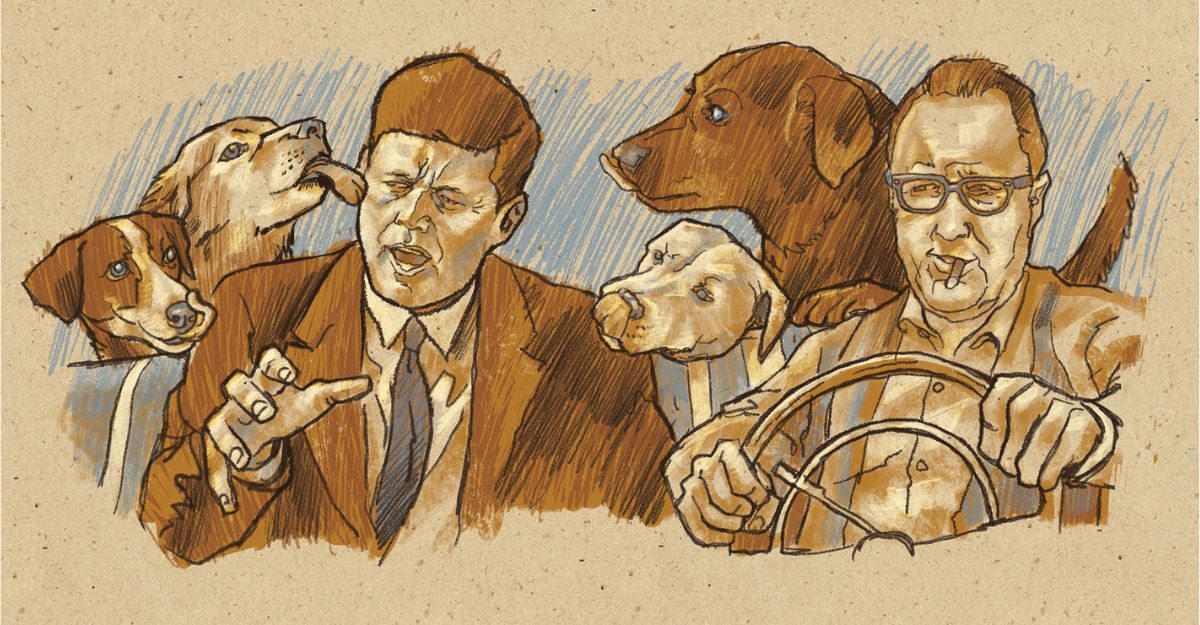
Walt Marshall, owner of the Brewery Theater, sensed an opportunity. He was more than happy to offer up his 1957 Pontiac Safari as a presidential limousine. The only problem was that it was festooned with foot-high letters reading "BREWERY THEATER—BROADWAY'S FINEST PLAYS—LAST CHANCE GULCH—MONTANA," and contained four large dogs to boot. Protests were made that the candidate couldn't ride in a mobile advertisement like Marshall's Safari. Well, fine, Marshall told them. Call a taxi, then.
Kennedy reluctantly got in the car, and right away Marshall was driving them away from the airport the wrong direction. Maybe they could stop by the Brewery Theater for a moment? There was a couple there he'd like Kennedy to meet, as they were from Boston. The whole way there, Marshall's dogs lapped at the back of Kennedy's neck. Kennedy arrived at the airport on time, but "irked," as Christopherson wrote, and with a wet neck.
It wouldn't stop there. Kennedy's pilot and crew were missing. When they returned at last, Kennedy may well have still felt irked. He asked them where they'd been. Since he'd given them the day off, they had decided to drive to Great Falls.
"We'd have made it," they told him, "but we ran into cows at Wolf Creek Canyon."
A crowd had assembled to see him off, and Kennedy was tired but gracious. As he took a phone call he offered to let folks look through his plane. He finally took off at 9:20, nearly three hours late.
Kennedy won the presidency of the United States in the election of 1960, even though he lost Montana. The final tally was 141,841 for Nixon to 134,891 for Kennedy—a margin of nearly 7,000 votes. It was the first time since 1900 that Montana had backed the losing candidate in a presidential election. Even so, Montana had a float in the inauguration parade, on which waved costumed cowboys and Indians. Marie Merrill, the Reber family, and the Marshall family all attended, and when Kennedy noticed Joe Reber Jr. in the crowd, he singled him out with a friendly "Hi, Joe."
Mansfield, Montana's senior Senator, who had supported Lyndon Johnson over Kennedy in 1960, became one of the President's closest advisors. They met weekly.
Kennedy didn't neglect the Indians who had greeted him so warmly on his first visit to Montana. In March 1963, members of the National Conference of American Indians met with Kennedy in the White House Rose Garden. Walter Wetzel, a Blackfeet from Browning and president of the NCAI, presented Kennedy with a hand-carved gavel inscribed with another honorary Indian name: "Chief High Eagle."
"Are there any Crows in the crowd?" Kennedy asked. "I'm a Crow. Come on up front." Edison Real Bird, a Crow from Billings, presented him with a peace pipe.
Later, Jackie would give Real Bird and John Cummins, another Montana Crow, a tour of the White House nursery school. The Crow men told traditional stories and played a drum for the children. Real Bird and Cummins would check the mail sometime later to find that the First Family had sent them photos of the Crow men in the White House.
In September 1963, Kennedy returned to Montana as part of an 11-state conservation tour. His plane set down at the airfield in Billings at 3:19 p.m. to find 2,500 people waiting for him. From there he took a motorcade to Midland Empire Fairgrounds. He gave a speech there to a crowd of 17,500 people. He spent 15 minutes shaking hands with people over a fence, including one awestruck 12-year-old girl who kept trying to take her picture without realizing that the camera was still in its case. Kennedy reached over and patted her on the head, undid the lens cap, and posed for the picture. Someone came up and handed him a photograph to sign. Inspecting it, he was confounded for a moment when he realized that it wasn't a picture of him. Then he smiled and signed it when he recognized it as a portrait of Edison Real Bird, the Crow peace officer who had gifted him a peace pipe.
By 4:40 p.m. he was already back in the sky and on the way to Jackson Hole.
He was back at Billings the next day to change planes. Another 2,000 people awaited him, hoping for a chance at a handshake. One of them was 17-year-old Judy Webb, a student of Central High who was confined to a wheelchair. Kennedy saw her and leaned over the fence to talk just to her. He asked her age and whether she was a student and, Judy, tongue-tied, couldn't remember.
Christopherson wrote that "Mayor Fraser had sent Billings' four meter maids, Lois Bonawitz, Marjie Frank, Ann Smart, and Jerry Scovil to the airport, and JFK asked them about their uniforms. One of them remembers a Secret Service man going over, picking up a telephone, putting a finger in his opposite ear, and saying, 'No, there isn't any trouble. He's just shaking hands.'"
Then he boarded Air Force One and took off for Great Falls.
He arrived about forty minutes later to find another 2,500 people waiting, including Dick Spanish and Earl Old Person, two Blackfoot natives dressed in their traditional garb. Again he shook hundreds of hands before entering the motorcade and proceeding along the route to his speaking engagement at Great Falls Memorial Stadium. People lined the street the whole way—"1,000 per block the entire route," Christopherson writes.
Though Kennedy had only about two hours for the entire Great Falls visit, he made one unscheduled stop at the south side bungalow of the parents of Montana's Mike Mansfield. There, in the modest home of Patrick and Josephine Mansfield, wherein were proudly displayed copies of Kennedy's Profiles in Courage and PT-109, Kennedy asked Patrick, 86, what part of Ireland he was from.
Christopherson captures the moment that Kennedy "grinned when the elder Mansfield answered, 'Kilkenny—I left there in 1896, when I was 19.'"
To the elder Mansfield, Kennedy was, he would later say, "wonderful, just wonderful."
Mike Mansfield admitted it was "a perfect tribute," but opined that he "was worried something would go wrong, there were too many chances. I never would have approved it." Even so, "the South Side will never be the same."
At the stadium, Kennedy spoke to a crowd of 20,000, many times more than the 6,500 the venue was intended for. It was the largest public gathering in Montana history until that time. People were hanging from the goal posts at the far end of the field. He spoke about conservation, the development of Montana's resources, and the war against global communism. He sometimes rested his knee on the podium to relieve his back pain as he spoke.
After the speech, more pressing the flesh, more hands shaken. One four-year-old boy, riding on his father's shoulders, handed Kennedy a model of PT-109. A ninth grader by the name of Rosalind Breeze wept and smooched her own hand: "He shook hands with me!" The crowd chanted: "We want Kennedy! We want Kennedy!"
Then it was back to the airport again, with a stop at the Air National Guard hangar to shake hands with members and their families. At Air Force One, Kennedy saw Joe Reber once again. Buoyed by his warm reception in a state that he had lost in the general election, Kennedy greeted his friend once again. "This was the best reception we've had in our trip West," he told him. "Joe, I'll never forget that lawn social you had for me in Helena just before the convention."
Reber assured him that he'd never forget it, either. They should do it again sometime, he said, and the President agreed. After all, he'd be back to campaign soon.
Then JFK boarded the plane and flew off once more.
An assassin's bullet cut him down only 58 days later. Montana, whose citizens had come to feel they had known him, and even perhaps known the man well, if only for a glance or a moment's warm handshake, was as shocked and heartbroken as the rest of the nation.
Jackie Kennedy specifically requested that Montana politician Mike Mansfield eulogize her husband in the Capitol Rotunda on November 24, 1963. Mansfield, humbled, obliged.
A few days after that, Kevin Shannon, then the president of the Butte school board, introduced a resolution to rename Big Butte School as John Fitzgerald Kennedy School, the first but not the only memorial to JFK in Montana.
In his resolution, Shannon wrote movingly about what JFK had come to mean to him, his wife, and their children: "He was a teacher. He viewed education as the one human activity which would give substance to his vision of a world peopled by free men living without fear. His appeal for greater effort and achievement was made not just in the name of the intellectually well-endowed, not just in the name of the alert and aware, but also in the name of the average, the mediocre and those whom God has not quite finished."
The school proudly retains that name to this day.
Leave a Comment Here