Emerald Isle to Big Sky Country: the Ancient Irish Sport of Hurling Takes Root in Montana
The community of Butte has long been hailed as the epicenter of Irish heritage in Montana. Ask any Montanan which Treasure State city has the highest population of Irish residents, and they’ll surely name Butte every time.
As of the 2010 census, nearly one-quarter of the Mining City’s population was of Irish descent. With that statistic under its belt, Butte elbowed out other cities with strong Irish heritage—including Boston—to gain national recognition as the most Irish city in America.
It’s a title Butte displays proudly year-round, but perhaps never so prominently as during its annual St. Patrick’s Day festivities. Crowds flock to Butte by the thousands for the legendary March 17 celebration, which is capped off by the iconic St. Patrick’s Day parade.
Celebrants clad in green and glitter packed the city’s uptown parade route during the especially warm and sunny jamboree this spring. Spirited music filled the air and Irish flags waved enthusiastically in the breeze. Revelers lined the streets for the entire distance of the route, standing as many as thirty people deep on some stretches. Others sat atop buildings with their feet dangling off the edge, while more still situated themselves on stairways in tiered rows outside office buildings and storefronts, packing into every bit of sidewalk space available. The entire scene exuded cheer, joy, and a resounding pride for the city’s Irish heritage—but the best was yet to come.
Montana’s Hurling Teams
Among the convoy of businesses, organizations, musicians, public servants, education personnel, and political hopefuls who participated in the march through uptown Butte that day was a particularly fired-up group of rowdy, fun-loving men and women waving long wooden sticks in the air.
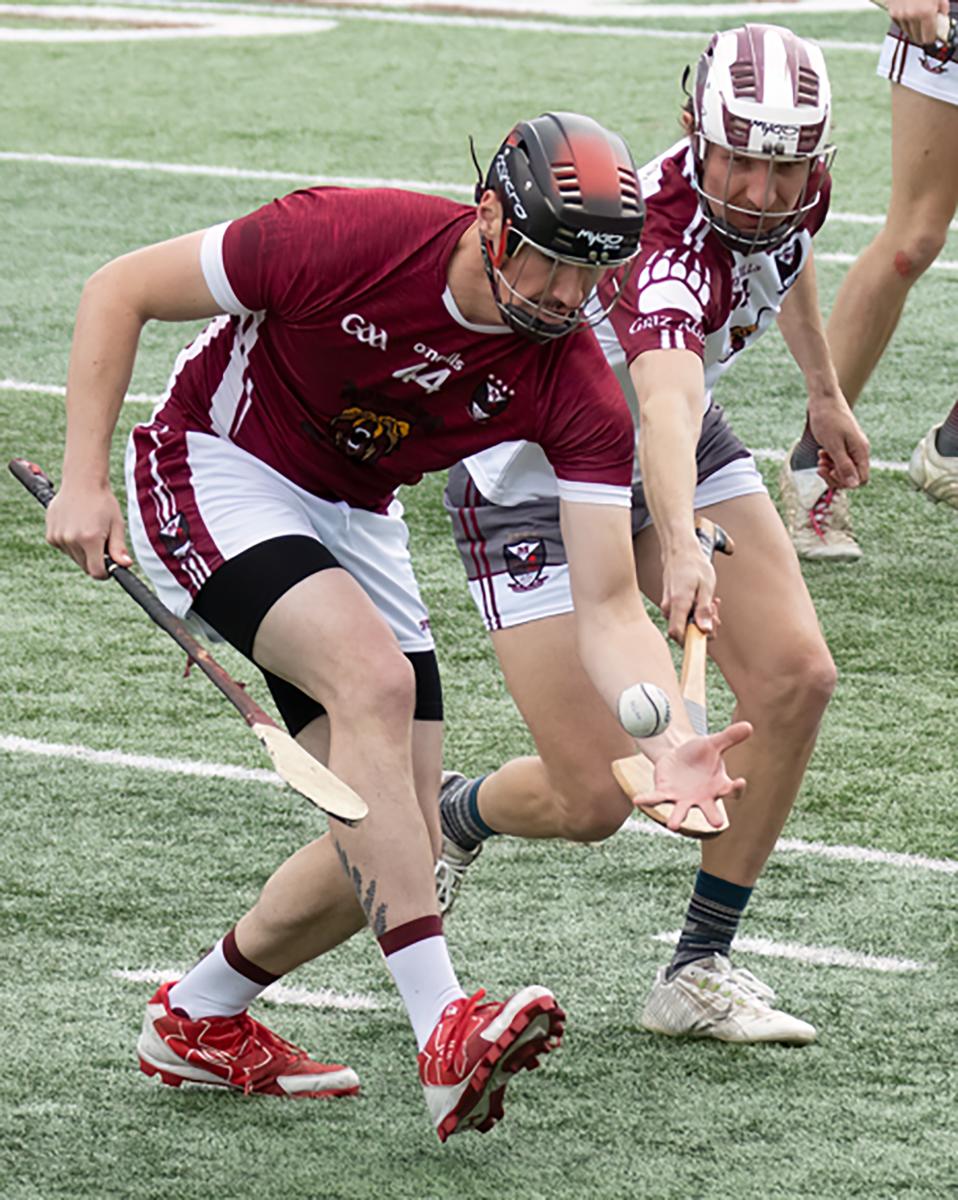
The sticks (known as hurleys) closely resembled those used in hockey, but instead of hitting a puck, this crew was using them to hit a small tennis-type ball back and forth as they worked their way down the parade route.
The group, a conglomeration of athletes primarily hailing from Butte and Missoula, were members of local hurling teams—and they were clearly a crowd favorite.
“Come to the Coliseum after the parade! Two p.m.,” members of the hurling group would yell out as they interacted with the cheering onlookers. “Come watch us play! It’s going to be crazy!”
I didn’t know much about hurling, but my curiosity was piqued. After all, when in Butte, America, on St. Patrick’s Day, you do as the Butte folks do!
An Ancient Sport on Display
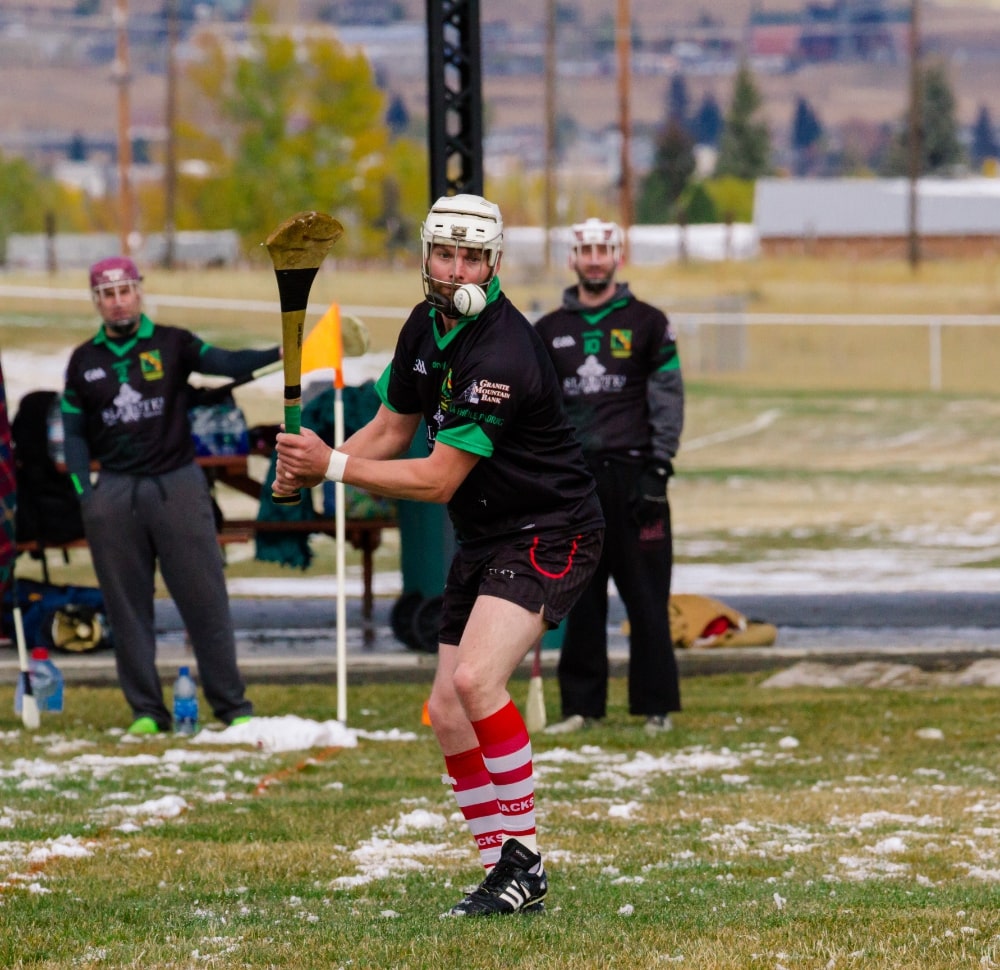
Hurling is an ancient traditional Irish sport deeply rooted within and tightly woven throughout Irish history and culture. It is a physically demanding, fast-paced game that combines elements of lacrosse, hockey, tennis, baseball, and soccer—though its origins predate them all.
The sport’s first literary reference dates as far back as 1272 BC, according to the Gaelic Athletic Association (GAA). The game evolved from a regimen used to train ancient Celtic warriors, and was once far more violent and dangerous than the version played today. Back then, if a warrior survived and was proficient on the hurling field, he would likely be skilled, fierce, and triumphant on the battlefield.
“Hurling can be traced back through thousands of years of Irish culture and folklore,” says Conn Butler, a lifelong hurler who hails from Galway, Ireland, and now resides south of Havre with his wife and two sons. “It is widely accepted as the most definitively Irish sport we have. Along with speaking the native language, you really couldn’t do two things that are more Irish. It’s so uniquely ours.”
Athletes playing the sport in the United States today generally carry out games on football fields. The fields, called “pitches” in the context of hurling, are smaller than Irish pitches, so only 11 to 13 players make up each team as opposed to the 15 players per team in Ireland.
Athletes don their kits—team-specific jerseys, shorts, socks, and helmets—as they battle through two 35-minute halves. The overarching goal of the game is to hit the ball (knows as a sliotar) over the crossbar of the opponent’s goal (for one point), or beneath the crossbar and into the opponent’s goal (for three points).
They must simultaneously defend their own goal while also evading their opponents.
“It’s basically a free-flowing field sport where the ball is in constant motion,” explains Myles Maloney, president of the Thomas Meagher Hurling Club out of Missoula. “That’s why it is known as the fastest game on grass. You’re striking the ball the length of the field at times, and the entire field is in play.”
Hurling is also extremely physical and hard-hitting.
“It’s this crazy-ass sport that looks dangerous as hell,” Maloney laughs. “It takes the hand-eye coordination of baseball. There are principles of tennis because you’re striking on the run. You need field awareness of soccer players. There are elements of hockey. Hurling requires all these different skillsets from all these different sports.”
Ryan Mulcahy, founder, president, and coach of Butte’s Wolfe Tones Hurling Club, describes hurling as “the rugby version of lacrosse.”
“People are familiar with lacrosse and they know rugby is rough,” Mulcahy says. “In hurling, there’s no pads or protective gear with the exception of the helmets. It is a nonstop game for 35-minute halves. The only time you stop running is if the game stops for an injury or because the ball went out-of-bounds.”
Hurling makes for a thrilling spectacle, rife with a fervent fandom that fuels the athletes and builds a unifying sense of community and comradery.
“You have to see it to really understand it, and that’s why we’ve been doing the St. Patrick’s Day game every year,” says Mulcahy.
Bringing Hurling to Montana
The first organized hurling club in the Big Sky state was founded in Missoula in 2013 by Naoise Waldron, an Irish Fulbright Scholarship student, and Brian Barry, an Irish exchange student.
“We have an amazing Irish studies program at the University of Montana (UM)—one of the biggest programs in the country,” says Maloney. “Dance, language, art history…it is a phenomenal program.”
But when Waldron and Barry learned there were no hurling clubs in the area, they knew they needed to think fast.
“Here they are in the middle of Montana and they’re so excited to be here,” Maloney explains, “but they also weren’t going to go a whole year without having hurling in their lives.”
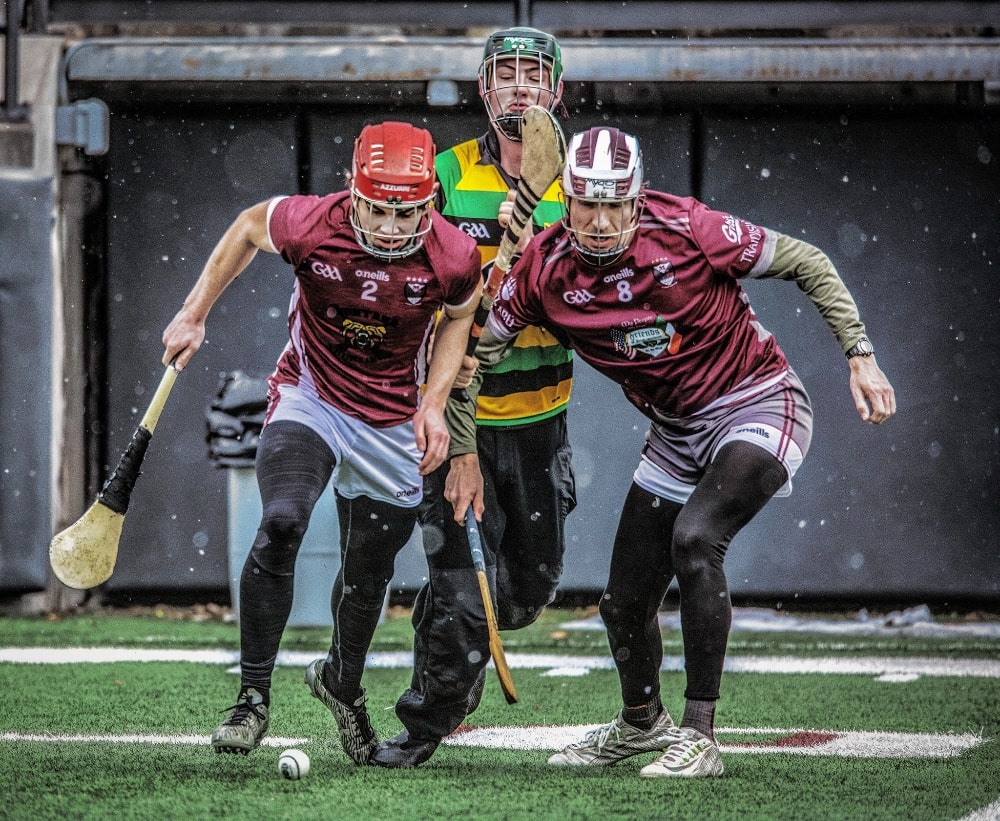
They founded UM’s Montana Grizzlies Hurling club that same year. Soon thereafter, the team gained the attention of the National Collegiate Gaelic Athletic Association (NCGAA), which is the U.S. collegiate-level version of the GAA. They began traveling around the country, racking up win after win against well-established teams along the way.
“The Griz had such strong athletes on the team, they wound up winning the national championship their very first season,” Maloney says of the coed club.
The following year, Barry successfully lobbied to have UM host the 2015 national championship. The matches were held at the Washington-Grizzly Stadium.
“All these teams came to Montana and we won it again,” Maloney recounts. “The Griz went undefeated, just wiped the walls with everyone, and won back-to-back national championships!”
The team racked up another set of back-to-back national titles in 2017 and 2018.
Maloney was inspired to start up a non-collegiate hurling club after watching a championship and meeting with players after their epic win. The Butte native founded Missoula’s Thomas Meagher Hurling Club in 2015.
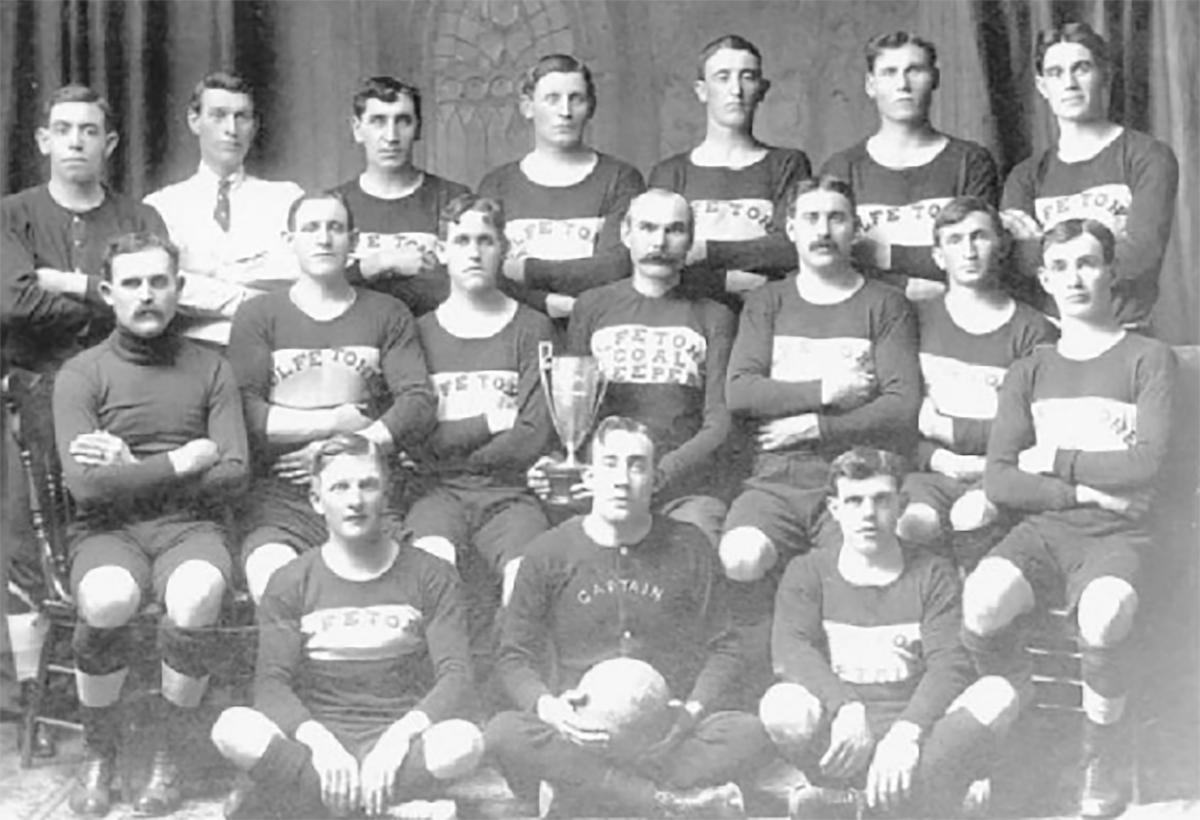
Mulcahy, who graduated from Butte Central and has lived much of his life in the Mining City, went to watch Maloney and his club play when they came to town for the St. Patrick’s Day parade in 2017. He became even more interested in the sport after he and his seven-year-old son attended a hurling clinic the Thomas Meagher club hosted in Butte.
“We had an absolute blast,” Mulcahy recalls.
He received an unexpected call from Maloney months later.
“Myles calls me up in September of 2018 and says, ‘We’re going to have a hurling tournament in Butte in October. Get as many people together as you can to play,’” Mulcahy says. “It was less than a month away! But I was able to round up six players who were interested.”
The problem was, none of them knew a thing about the game they were slated to participate in, and the gear they needed isn’t available at the local sporting goods store.
“I ended up ordering six hurls from Ireland,” Mulcahy says. “We took them down to the grass field and pulled up videos on YouTube to learn how to play.”
The tournament went off without a hitch, save for subzero temperatures and an inch of snow on the ground.
“It was one of the most fun things I have ever done,” he notes. “After the tournament, I decided Butte was going to have a hurling team.”
The Wolfe Tones Hurling Club was officially established by the end of the year.
Maloney says a fourth Montana team, the Glacier Hurling Club, is currently forming in the Flathead area. It is headed up by one of the founding members of the Thomas Meagher club.
It is not uncommon for members of other clubs within the division to help fill out the rosters of some of the younger Montana hurling teams.
“We’re still in the infancy of our team building,” acknowledges Mulcahy, who sometimes borrows players from the Griz team.
“People come and go,” Maloney adds. “We recruit people, they train with us, they get better, they fall in love with the hurling community, and then they move. We have players who have relocated to D.C., Portland, China…so we’re constantly recruiting and encouraging people to get active and come join up with this great group of people.”
Players must be at least 18 years old due to insurance requirements, but that’s where the limitations end. Maloney says he was 35 when he took up the sport nearly a decade ago.
“We have a couple of guys over 50 who come out and play with us,” he says.
Community, Comradery, and Reconnecting with Culture
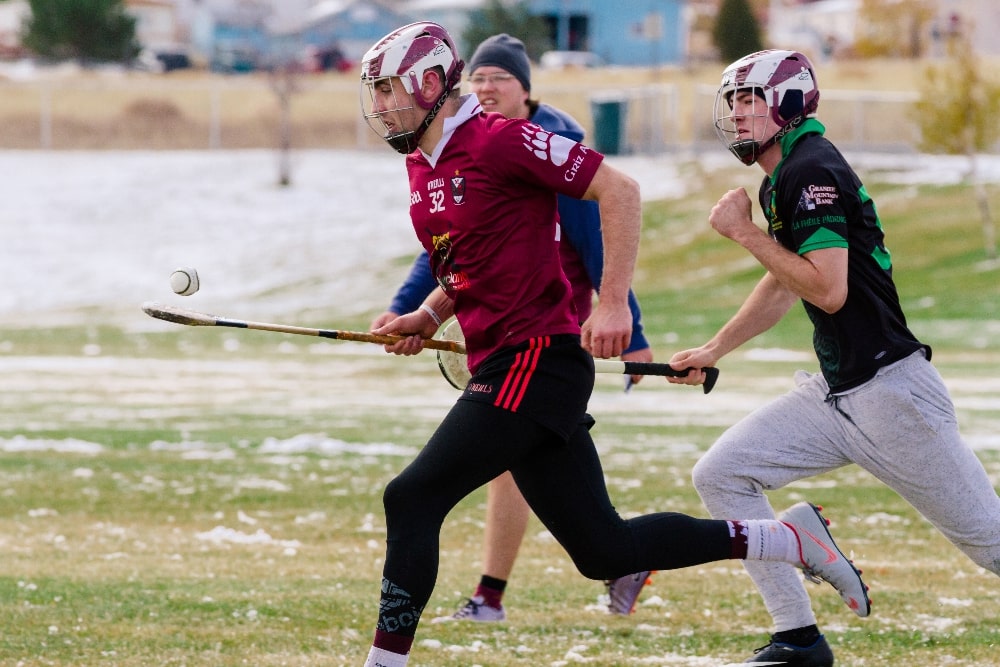
In Ireland, nearly every town, small village, and parish has its own GAA club.
“Take, for example, a small, rural village community with not much more than a church, a small shop, and maybe a pub,” Butler says. “This place will 99% of the time also have a GAA club with the pitch located at the heart of it all. It brings community spirit, a sense of belonging to where you are from, and is a great outlet for all ages of people.”
People celebrate their shared heritage within these social hubs, further deepening the bond between the Irish identity and hurling itself. The matches foster a strong sense of pride and unity, while simultaneously embodying the “against-all-odds” and “never give up” mantras that reflect the Irish spirit.
Maloney describes the Montana clubs as “one giant hurling gang.”
“We practice together, train together, travel together…it’s really one big family,” he says. “We take care of one another.”
That sense of comradery isn’t bound by team affiliations.
“We have built friendships with players on the other teams, too,” Mulcahy says. “We might beat the hell out of each other on the field, but we’re going to go have beers together afterwards.”
Teaching the next generation about the Irish culture is also of the utmost importance to Maloney, who was recently awarded the title of 2024 Irish Man of the Year by the Ancient Order of Hibernians in Missoula in connection with his work.
“A highlight of the year is early March, when we take over all of the gym classes in Butte for the whole day and get to teach 250 kids and teachers about hurling and help them learn fun Irish words,” he says of the effort. The team has also held similar sessions in Missoula. “Getting into the schools is awesome.”
Based on the enthusiastic turnout at this year’s St. Patrick’s Day game at Montana Tech’s Alumni Coliseum, the clubs’ outreach efforts are paying off.
“Fifteen years from now, I want everyone in this town to know what hurling is. I want them to go and learn the history of the GAA and the unity it brought to Ireland in times of persecution,” Mulcahy says. “I want the community to learn about hurling and to build the culture that doesn’t exist here yet.”
Montana’s hurling clubs wholeheartedly welcome new members and encourage anyone interested in the sport to come try it out. To learn more, check out the teams’ social media pages, or visit www.wolfetones.club.



Leave a Comment Here