
Sugar Beets and Tumbleweeds: Billings Through an Artist's Eyes
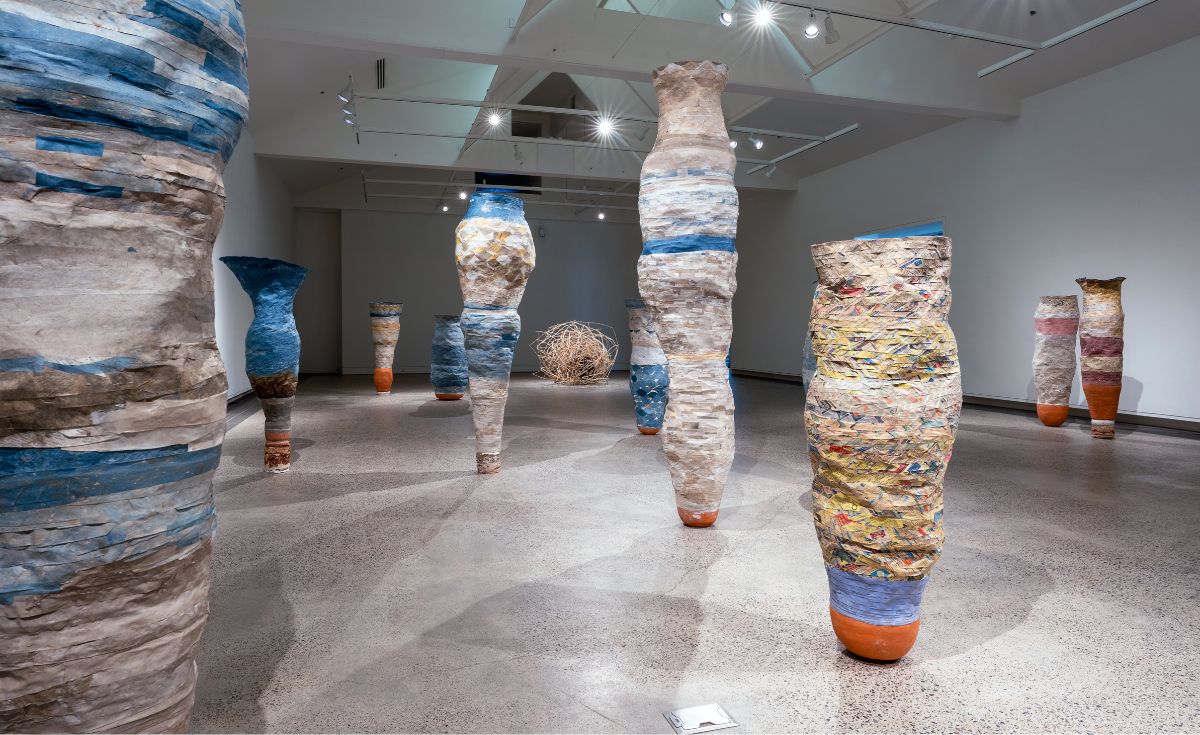
When sculptor Rebecca Hutchinson first encountered the gallery where she had been invited by the Yellowstone Art Museum (YAM) to create a show based on the history, culture, and environment of Billings, she knew she would have to go big. A 100-feet long room with soaring 30-feet ceilings, the space asserts itself in all directions. "I had to build big, which is indicative of what I do, I build large, but I had to build really large in this space," Hutchinson says, and remembers thinking, "I can't just build a lot of something, I also have to move up in space."
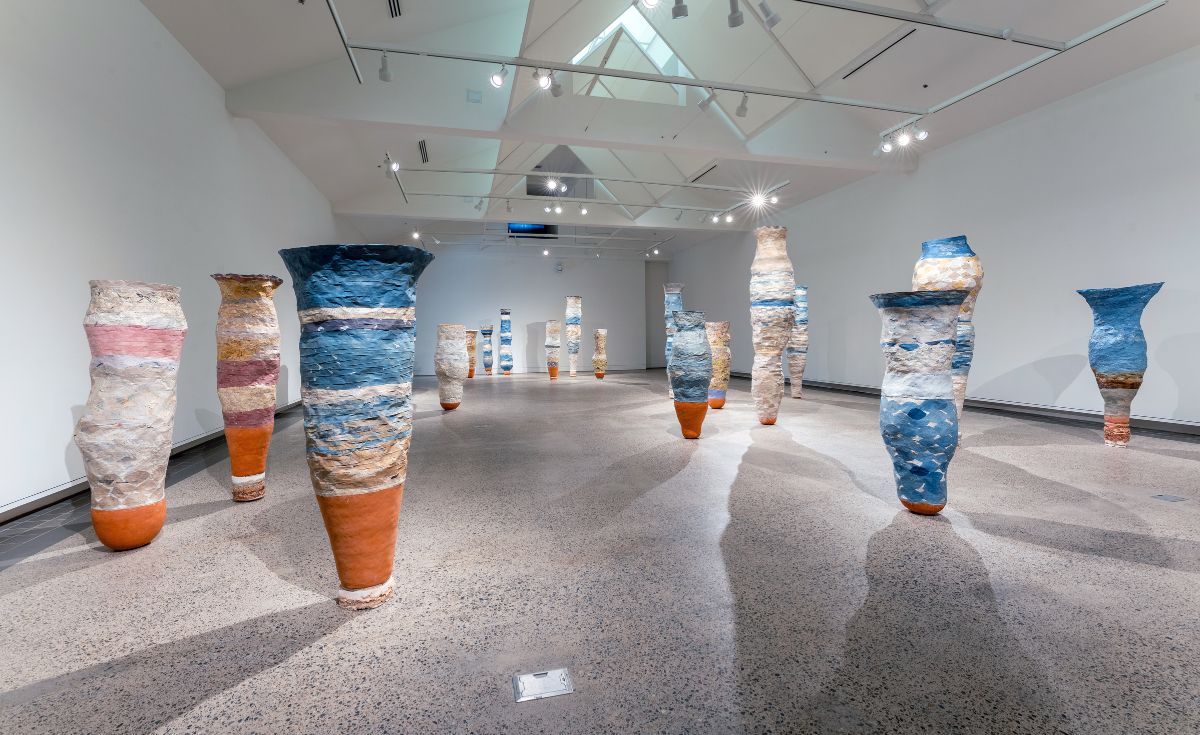
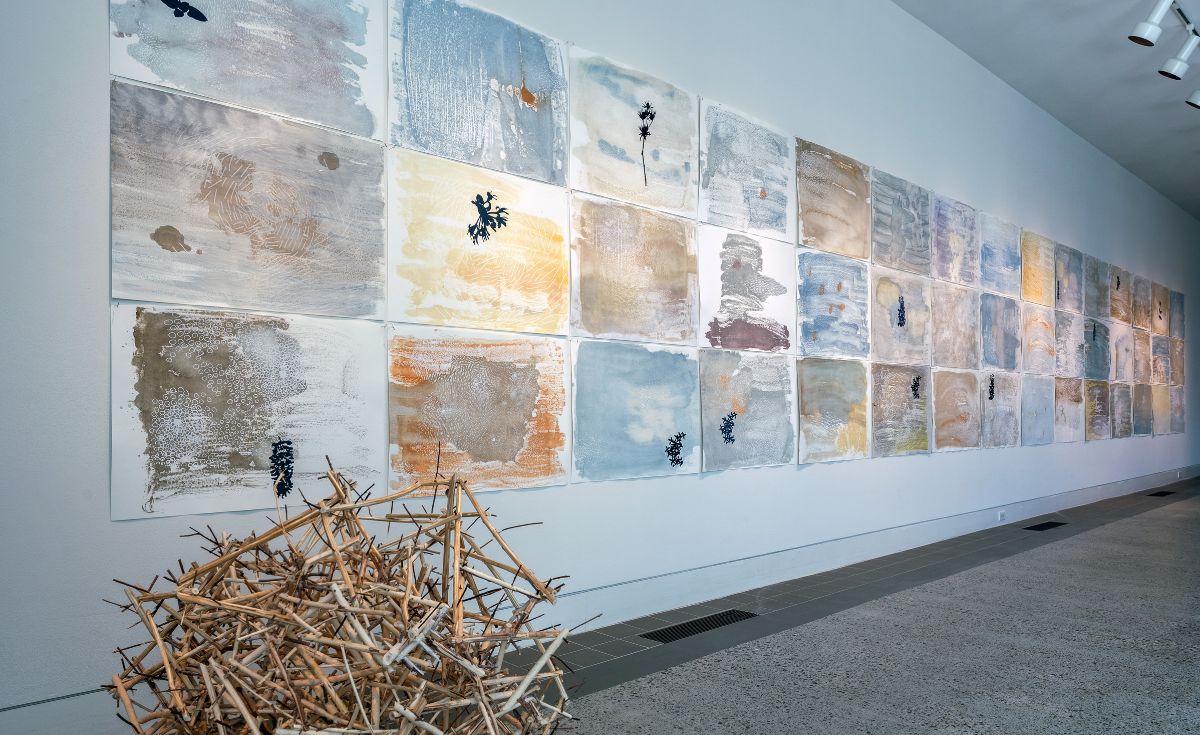
Embedded in the Overlap, on view at YAM through January 9, 2027, is Hutchinson's response to this challenge. Vernacular materials abound. Twenty-two towering sculptures of beetroot paper and clay, ranging from seven to 15 feet in height, run like a multi-colored forest down the length of the gallery. A mammoth tumbleweed woven of creek willow anchors one end of the room. The installation sprawls out into the hallway, where more tumbleweeds and 45 prints featuring wind evoke the region's intense weather. "A tumbleweed goes until it hits something, a fence, a tree," Hutchinson says. "It's loaded with metaphor and meaning to me, it's a plant that detaches and it moves from place to place and regenerates seed as it moves."
Formally trained as a ceramicist, Hutchinson's practice has evolved to encompass both clay and paper sculpture. The latter was always a personal passion, and she remembers when the two mediums came together for her while in residency at the Archie Bray Foundation for Ceramic Arts in Helena. Accompanied by her husband and 11 month-old daughter, Hutchinson moved to Helena in 1993, and over the next two years fell in love with Montana while honing her craft. Thirty years later, Hutchinson is a professor of ceramics at University of Massachusetts Dartmouth, but she and her husband still spend every summer in Helena. She has a barn studio outside Clancy, which affords her the room to develop the large-scale, site-responsive installations that museums the world over invite her to build in their spaces. Hutchinson committed two years to the conception of Embedded, a longer time than she has spent on any place-based exhibition to date.
When developing her site-based pieces, Hutchinson's process is systematic. She always starts by encountering in person the space she has been asked to fill. She then turns to research, sifting through regional history books, field guides, archival photographs, and newspapers. With Embedded, she knew that the tension between Yellowstone County's indigenous history and the transformations set off by the Homestead Act would be intrinsic to whatever form her exhibition eventually took. "This is a show about layers of history and layers of change, both positive and negative, it's all in there," she says. "If you want to get political about it, we eradicated native plants and we eradicated native use of the land. It's complex, and we need to be sensitive about that."
To accelerate settlement of the American West, the federal government passed the Homestead Act in 1862 and began offering 160-acre plots of land, for free, to anyone who filed a claim and managed to stay for five years. The United States had obtained this land via treaties with Native American tribes, whose traditional land use ethos does not encompass "ownership" in the same way that the Euro-American legal system does. As a result, Native Americans unwittingly agreed to the permanent cession of their ancestral hunting grounds, an event that continues to have ripple effects.
One of the key research questions Hutchinson sought to answer was how Billings had solidified economically after the homestead era, and this question brought her to the story of the sugar factory on Billings' south side, operated today by the Western Sugar Cooperative. The plant opened in 1906 and was long considered the largest sugar mill in the world. Built by the locally organized Billings Sugar Company, it came under the Great Western Sugar Company in 1918. The factory processed sugar beets brought in by rail from all over the state. Today, sugar beets continue to come in by truck from late summer through October, and processing runs through February. The surplus beetroot pulp is then either buried or sold for animal feed. People who grew up in Billings remember the smell of sugar beets in the winter as "burnt peanut butter," a smell that, whether they loved or hated it, meant home.
Hutchinson saw an opportunity, and asked her contacts at Western Sugar if they would save some beetroot pulp for her. Come February, they presented her with a 20-pound sack of beetroot, which she describes as "very beige, very fibrous." Hutchinson boiled the pulp, used a hollander beater to mix the plant fibers into a homogeneous sludge, then poured the sludge into a huge eight-foot rectangle. When it dried, she was left with beetroot paper, 500 sheets of it to be exact. She was worried the beige alone would be dull, so she made 500 more sheets of paper out of old blue jeans. These sheets of paper she then dipped into a clay slurry, and formed her sculptures from there. Some of the sculptures appear rooted to the earth, thanks to hefty "wedding cake" stands formed from striations of clay sourced from six wild clay pits around the state. Other sculptures seem more precarious, softly touching the floor with rounded bottoms.
Hutchinson explains that as an artist, she has always been particularly sensitive to the forms that "home" takes on the landscape, whether it be human- or animal-built. When her daughter was born, she found that her artistic focus moved to "looking at how species were providing care. I really zeroed in on architectural nesting structures, insect structures, I love the beaver dams, but I think all of the birds I saw in Montana, that was really monumental, and that is about nurtured space. Home, survival, cautiousness, carefulness, safety." From paintings of Native American encampments nestled on riverbanks, to soddies built of hewn prairie turf, to magpie nests assembled of anything and everything within reach, Hutchinson's research for Embedded clarified for her how a "home" can touch space with purpose and sensitivity at the same time.
Embedded in the Overlap remains on view at the Yellowstone Art Museum through January 9, 2027. Housed in the historic county jail, YAM sits at 401 North 27th Street in downtown Billings and is open Wednesday through Saturday, 10 am through 5 pm (8 pm on Thursdays). Admission is free for Yellowstone County residents, $8 for adults, and $6 for seniors. YAM is also a self-guided destination for attendees of the annual Montana History Conference, hosted by the Montana Historical Society and running this year in Billings from September 24-26.










Leave a Comment Here