Category

  • Gil Mangel's Diorama of America

    By Joseph Shelton, with photos by Rick Szczechowski
    Given its international and even sometimes cosmic range of artifacts, it is a model of one Montana man's view of the America he grew up in. That it is presented with all of the oddity, strangeness, and good humor of its founder elevates it above the merely informational into the rarified realm of the miraculous.
  • The Weights Our Nation’s Warriors Carry

    By Holly Matkin, with photos by Bryon Gustafson
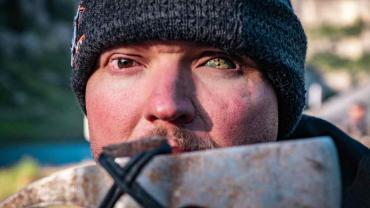
    Participants might cover miles of blowdown trees and dozens of creek crossings in the rain. "By day two, everyone is exhausted and wet," Urick says, recounting one recent trek. "But that's where the magic happens. They realize they can 'suffer well' and that this experience was exactly what they needed."
  • Lichen: A Love Story

    By Joseph Shelton, with photos by Tim Wheeler
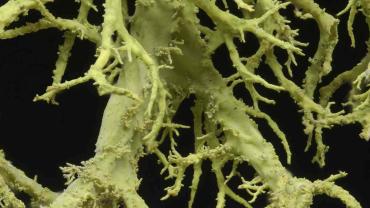
    In fact, they work so well together that some scientists think that, if the nutrients are ample enough and in the absence of the few factors that can actually kill them, lichen is functionally immortal and does not grow old.
  • Journey Through History at Montana's Newest State Park: Judith Landing

    By Ednor Therriault
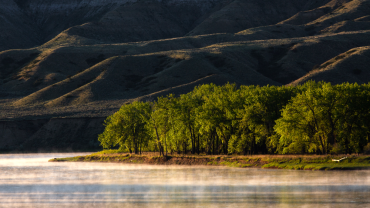
    Across the bridge on the south bank is the site of the new state park, comprising a 109-acre parcel acquired by the state in 2025. It includes the Judith Landing Historic District, which contains the remnants of several structures from various periods in the confluence’s history, and encompasses notable historic events that date back, oh, 150 million years or so.
  • Get to Know Ravalli County

    By Bryan Spellman
    Sixteen miles south of Florence by US Highway 93 lies Victor, named for Salish Chief Victor, who as a youth met Lewis and Clark at Ross’s Hole. Today’s Victor is home to Hamilton House, an authentic Scottish pub serving the best fish and chips I have ever had. And if you are an aficionado of Scotch whiskey, the bar has one of the widest selections this side of Scotland.
  • Montana Media: "All the Young Men" and the Power of Poitier

    By Kari Bowles
    The crew arrived at St. Mary’s, Montana, one of the Eastern gateways to Glacier National Park, for location shooting. Alas, the weather interfered, as the weather in Montana will do. Heavy fog, blizzard conditions, and a massive windstorm that trashed the farmhouse set resulted in delays.
  • The Tradition of Spring Branding Lives On

    By Todd Klassy
    Hugely popular television shows and movies have made cowboy culture popular again, but branding is more than just a passing fancy found in Hollywood scripts. In Montana, it is tradition.
  • Keeping the Rails Clear

    By Justin Franz
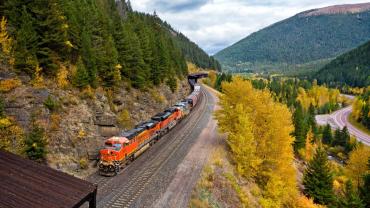
    The elements only grew more difficult the farther west the railroads built, especially as they reached the Great Plains and Rocky Mountains toward the end of the 19th century. While the locomotives became more powerful each year, even those fire-breathing machines of iron and steel could be hampered by deep snow.
  • "Shane" and A.B. Guthrie

    By Kari Bowles
    Alfred Bertram Guthrie, Jr. was born January 13, 1901, in Bedford, Indiana. His parents moved to Choteau, Montana, when he was six months old; he would have an attachment to Choteau all his life.
  • Anaconda, Prettiest Little Town in Southwest Montana

    By Sherman Cahill
    It feels like the sort of place where scenes from Norman Rockwell play out behind every closed door. There’s street after street of adorable homes nested in beautifully maintained yards, watched over by lovely old neighborhood churches.
  • The Montana Hope Project Fulfilling Wishes, One Child at a Time

    By Holly Matkin
    Among the most impactful elements of the Montana Hope Project are the feelings of inclusion and comradery that continue to flourish long after a child’s wish is granted. Hundreds of family members and wish recipients attend each of the twice-yearly reunions held at Fairmont.
  • Three Snapshots of Underwater Montana

    By Nick Mitchell
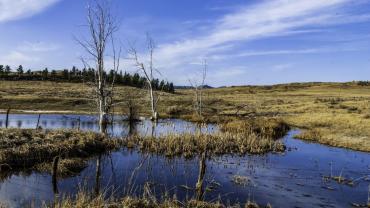
    The sky turns slate as thick, billowing clouds gather darkly in the east, blowing in from the Panthalassic Sea. The insects hush, suddenly, moments before sheets of warm rain begin to fall, dappling the leaves and disturbing the surface of the waters.
  • Learning To Dance With a Ski Pulk: 900 Miles Through the Backcountry

    By Hallie Zolynski, with photos by the author
    Using a pulk or sled to get around in winter and spring isn't a new concept. They were originally made of wood but are generally made using plastic now that can take a certain amount of weight. The shape of the pulk determines what it's best used for and needs to be able to run across the snow smoothly.
  • Montana American Legion’s Highway Fatality Markers Program

    By Holly Matkin, with Photos by the Author
    They stand solemnly alongside the state’s highways and interstates, flashing by with no particular cadence—one cross here, another six miles down the road, a cluster of five attached to a single post 50 miles later.
  • Paving Montana

    By Ednor Therriault, with photos by Tom Rath
    The Good Roads advocates wanted better, smoother roads for the popular new craze sweeping the nation: the bicycle. At the forefront of this effort was the League of American Wheelmen (LAW), which had been lobbying for better roads since 1880.
  • A Brief and Tasty History of the Beef Pasty

    By Joseph Shelton
    But those first Cornish miners brought with them a delicacy that many Montanans still treasure, a simple hand-pie that continues to nourish and fuel hard-working folks today. 
  • The Lakota Delegation: Portraits from 1868 - 1877

    By Douglas Schmittou
    Studio photographs of Spotted Tail’s wife and Running Antelope, a Hunkpapa headman, were taken by Gardner in Washington, D.C., during 1872. Running Antelope was splendidly dressed in a magnificent quilled shirt, peace medal, dentalia-shell ear pendants, otter-fur hair wraps, and three eagle feathers, one of which bears specific war-exploit markings.
  • Get To Know Flathead County

    By Bryan Spellman, with photos by the author
    The Great Northern Railroad, building its way west, reached Kalispell in 1892, and built their depot at the north end of downtown. In 1904, the railroad moved its main line north to Whitefish, leaving Kalispell to be served by a spur line only.