People & Place

  • Get To Know Big Horn County

    By Bryan Spellman
    With the creation of Montana Territory in 1864, all land east of Bozeman Pass was called Big Horn County. So few settlers lived in this vast area that the entire eastern part of the state fell under Gallatin County's jurisdiction.
  • Montana American Legion’s Highway Fatality Markers Program

    By Holly Matkin, with Photos by the Author
    They stand solemnly alongside the state’s highways and interstates, flashing by with no particular cadence—one cross here, another six miles down the road, a cluster of five attached to a single post 50 miles later.
  • The Tradition of Spring Branding Lives On

    By Todd Klassy
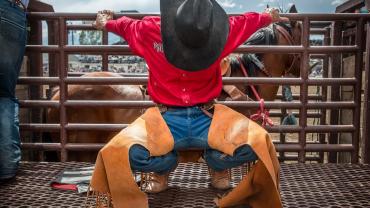
    Hugely popular television shows and movies have made cowboy culture popular again, but branding is more than just a passing fancy found in Hollywood scripts. In Montana, it is tradition.
  • Get To Know Blaine County

    By Bryan Spellman
    Roughly 15 miles south of Chinook, you will find one unit of the Nez Perce National Historic Park. The park, also known as the Nee-Me-Poo Trail, commemorates the 1877 trek made by 750 Non-Treaty Nez Perce Indians from Joseph, Oregon to the Bears Paw Mountains.
  • Anaconda, Prettiest Little Town in Southwest Montana

    By Sherman Cahill
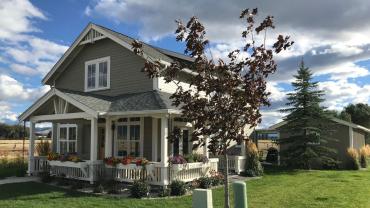
    It feels like the sort of place where scenes from Norman Rockwell play out behind every closed door. There’s street after street of adorable homes nested in beautifully maintained yards, watched over by lovely old neighborhood churches.
  • Montana's Grain Elevators

    By Teresa Otto
    Across the Great Plains in both the U.S. and Canada, up to 30,000 prairie skyscrapers dotted the landscape during their heyday in the 1920s and 1930s. Today only about a third of the old wooden grain elevators are left. 
  • A Brief History of Passenger Rail Service in Montana

    By Shawn Vicklund
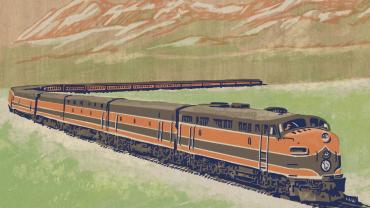
    Let's go back in time to understand the future. The year is 1883, and American railroads were transporting moving passengers over thousands of miles of rail lines that covered North America. Since the first railway 56 years earlier in 1827, railroads were now shrinking travel time between cities from days down to hours.
  • Warrior Spirit: Celebrating Native American Veterans

    By Ellen Baumler
    While some of Montana’s Indian veterans have been individually honored, the contributions of many others remain unrecognized. The Warrior Spirit Project Consortium, created in 2019, aims to change that.
  • Lakeshore Cabins and Campground Will Give You the "Don't-Wanna-Go Blues"

    By Joseph Shelton, with Photos by Lynn Donaldson
    I start thinking about all of the stuff that I presumably went on a getaway to get away from—bills to pay, offices to sit in all day, responsibilities to mind. If you're like me, you get a sort of hangdog feeling a few days after coming back, as if in mourning for your dear departed excursion. I call it the "don't-wanna-go blues."
  • Great Falls: Defined by the Railroad and the Falls

    By Russell Rowland
    Perhaps one of the most significant towns that originally came about because of the railroad is Great Falls, although Great Falls developed a strong foundation around many other industries after its founding.
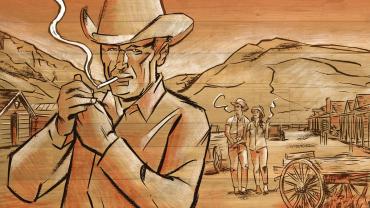
  • Dorothy M. Johnson's Recycled Cinema

    By Sue Hart
    In the 1940s and early ‘50s, a double feature always included at least one Western, usually depicting Hollywood’s version of what Johnson claimed as her West—the frontier on which she set the majority of her stories.
  • Beautiful Montana Roads for All Seasons

    By Todd Klassy, Photos by the Author
    These are some of my most favorite drives in Montana, regardless of the season. But I think they can be appreciated even more so in the colder months of the year. So, grab your Thermos of hot cocoa, an extra warm blanket or two, and your best winter tires. Let’s go for a drive.
  • Old Red and 27 Seasons of Calving

    By Holly Matkin    
    Her body’s muscling and fat cover rival those of cows one-fifth her age, but the reality of time is less hidden in the telltale angles and shadows of her fa
  • Montana on The Move!

    By Rob Rath
    Historically, agriculture has always been Montana's foremost economic engine from jobs to exports. Because of the Great Depression and World War II, only 30% of working farms used gas-powered equipment into the 1940s, while the rest still relied on horses to work in the fields.
  • Get To Know Chouteau County

    By Bryan Spellman, with Photos By the Author
    Of special note is the Chouteau County Court House.  Built in 1883, to replace the original court house destroyed by fire that year, today the building is the second oldest court house still serving that function in the state of Montana.
  • Get To Know A County: Rosebud

    By Bryan Spellman
    Roughly halfway between Lame Deer and Colstrip, the Deer Medicine Rocks are a National Historic Landmark, located on private property with no public access. The landmark memorializes the site where Lakota Chief Sitting Bull had a vision foretelling his success over the U.S. 7th Cavalry led by General George Armstrong Custer.
  • Get To Know Fergus County

    By Bryan Spellman, With Photos by the Author
    Located at the geographical center of the state of Montana, Fergus County was formed on March 12, 1885, with land taken from Meagher and Chouteau Counties. James Fergus, a territorial delegate from Meagher County, proposed the new county, and it was named for him.
  • Get To Know a County: Carbon County

    By Bryan Spellman, with Photos by the Author
    Carbon County has sixty-six listings on the National Register of Historic Places, including eleven in Red Lodge. The county courthouse and the former Carbon County Hospital and Sanitorium are both part of the Red Lodge Historic Commercial District.
  • Haunted Hotels of Southwest Montana

    By Sherman Cahill
    Suddenly and without explanation, he discovered a solitary elk steak on the hallway floor. Then another here. Another couple there. It was 6 or 8 elk steaks all told, and Lee still can't figure out who, or what, is responsible for moving them.