The Life and Afterlife of Comanche
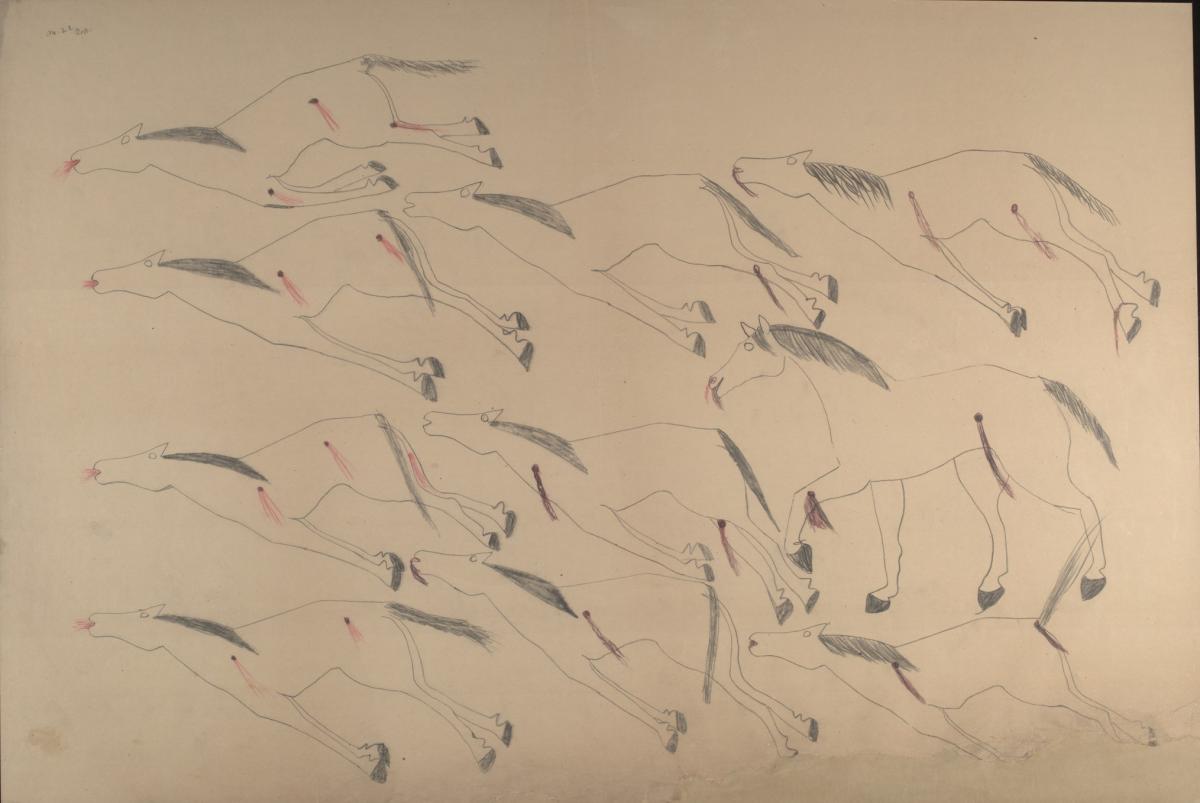
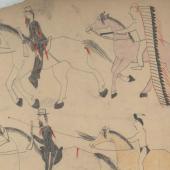
On the hot Sunday afternoon of June 25, 1876, thousands of Lakota, Northern Cheyenne, and Arapaho warriors surrounded 210 cavalrymen led by Custer and cut them down.
Amid the firing and screaming, the pounding of hoofs on dust, Comanche was shot seven times while carrying Captain Keogh. Four hit behind his shoulder, another his hoof, and one in each hind leg. One bullet through his chest exited his flank and hit Keogh's knee. They probably fell together.
Most of the cavalrymen died on foot, running nowhere in particular but away from the innumerable pursuers. The rank and file were killed first. Custer spent his final minutes knowing he was already dead. As Mari Sandoz writes, Custer and his officers were "surely not killed so long as flight seemed possible," but were finally "killed only in the last desperate moments to delay the end."
The horse, bloodied, crawled into a ravine as warriors passed through the field of dead and wounded. Within minutes, any U.S. cavalryman still alive was dead. After the battle followed the taking of prizes, the mutilation of the defeated, and the removal of most of the Native dead.
The battle itself lasted only an hour and fifteen minutes. The celebration of the victors continued until, fearing reprisal, they abandoned their camp. After that, quiet fell over the Greasy Grass. Not silence, but quiet; as the siege on Reno's men a few miles away continued into the night, anything still living on the field would have heard the distant reports of rifle fire go on for hours, and throughout the next day until, in the evening, the great mass of Native warriors left for the Bighorn mountains, leaving the ruins of their giant encampment behind. And then the valley fell silent, save for the muted droning of greenbottles and flesh flies, and the occasional screeching calls of carrion birds.
On June 27, in the early morning, General Terry of the Montana Column inspected the far ridge through binoculars, examining first the few dark and white dots he could see there, and then the remains of the makeshift Indian village, apparently abandoned, nearby. The strange dots could have been the remains of a buffalo hunt. That would have explained why some of the objects were seemingly white, and some darker—the lighter color may have been skinned buffalo, their exposed tallow twinkling in the distance. The darker objects could have been buffalo that hadn't been skinned yet. But if that were the case, where were the figures of the humans and pack animals required to process and move all the meat? The ridge stood curiously, even ominously still.
The day before, Crow scouts had told them that Custer had been killed along with all of his men, but it seemed too absurd to believe. Most did not credit the news, but the Crow scouts traveling with Terry believed their comrades, as they were reported to start singing mourning songs and deserted their posts shortly thereafter.
Finally, Bradley and Terry split up, the former to examine the ridge and the strange objects, the latter to cautiously probe the apparently empty Indian village. In the village, they found hastily abandoned cookware and other sundries. Musician George Berry of Company E reported seeing "lodge poles, buffalo robes, pots and pans galore, and in one place I saw a stack of new milk pans among the camp." Berry theorized that the milk pans had been stolen from settlers in the Black Hills, since the gold rush in that region had recently broken out in Hunkpapa territory, the ancestral homeland of the Lakota.
If the hasty disassembly of the camp wasn't sign enough, they soon found other evidence that the unthinkable had occurred. Here and there lay trophies: boots, saddles, cavalry clothing, and, finally, three severed heads and mallets covered in bloody hair. Near the stream, a pair of tepees was discovered, with seven Sioux warriors laid inside them in full regalia, their horses arranged in a circle around the lodges. Following the river, they began to find more bodies, badly mutilated and full of arrows. The stench was overwhelming.
"After passing the camp we soon came to the ground that Major Reno and his command fought over, and wherever we saw a batch of feathered arrows sticking up we knew that there the body of a trooper lay, especially those who had life in them after they had fallen," remembered Berry.
As they marched on to relieve Reno's men, the true extent of the horrors they were to face became clear. Lieutenant Bradley, scouting ahead, discovered what the white shapes on the ridge truly were: the bodies of the men under the command of Custer, stripped of their clothes. The darker objects they had taken for unskinned buffalo were the men's horses, fallen where they had been struck, some used as desperate makeshift breastworks by their doomed riders.
Accounts from those who buried the dead vary widely—some found bodies stripped but untouched, others encountered remains maimed beyond recognition. Historian Thom Hatch suggests this variance reflects different areas of the battlefield rather than conflicting memories. Each tribe had its own way of marking defeated enemies. The Lakota slashed the thighs of their enemies, while the Cheyenne left the bodies of their enemies face down to avoid bad luck. Heads, legs, hands, fingers, and scalps were removed and strewn about the battlefield. Skulls were crushed or filled with arrows or bullets at close range. Eyes were shot out. Members were removed. Sgt. John Hammon wrote of finding Private John Armstrong's head stuck on a pole. Even some horses were mutilated.
Captain Tom Custer, brother of the General, was scalped, his head smashed in and then filled with arrows, his arm shot and broken, and his belly slashed open, an injury out of which "his entrails protruded," according to Lieutenant Godfrey.
George Armstrong Custer was intact but no less dead. Some controversy persisted over the state of his body. Sensationalist accounts in the first decade held that his heart had been cut out by Rain-in-the-Face, who had threatened to do just that to the Son of the Morning Star. Others, like Godfrey, insisted that Custer, though stripped naked, was untouched and almost appeared to be in repose. In an 1896 interview, Godfrey held that "The General was not mutilated at all; he laid on his back, his upper arms on the ground, the hands folded or so placed as to cross the body above the stomach; his position was natural and one that we had seen hundreds of times while taking cat naps during halts on the march." Elsewhere, he wrote that Custer was found with "his right forearm and hand supporting his head in an inclining posture like one resting or asleep." In short, he had the look of someone who had "fallen asleep and enjoyed peaceful dreams."
This may have been a lie of omission to protect the General's widow. Most have the General's thigh gashed in the Lakota manner. Some reports, including a letter Godfrey later wrote to a friend, had Custer's body found with an arrow lodged in the corpse's penis; some fifty years later, a pair of Cheyenne women claimed that they made their own mark on the body by inserting awls into the General's ears, so that he might hear better in the next life when he is warned not to attack their tribe. The Finnish historian Pekka Hämäläinen puts it succinctly: "He had left this world diminished, and he would enter the next diminished."
It fell to men tired from fighting and sick with nausea and grief to bury the dead. They had eight shovels between them; the task was insurmountable. Knives and cups had to make up for the lack. "For most," wrote historian Paul Hedren, "the so-called burials amounted to little more than respectful gestures." In some cases, it was deemed enough to simply straighten the body out. Some were left exactly where they lay.
Most, after two days in the heat, were unrecognizable regardless of the degree of mutilation. Adding to the difficulty was the curious fact that the names had been cut out of most of the men's socks as if in a deliberate attempt to obscure their identities. Where identification was possible, a matter of searching for relics that hadn't been scavenged by the enemy force, the "graves" were marked with a small piece of wood, most likely salvaged from abandoned lodge poles, with the soldier's name written on a piece of paper, inserted into a bullet, and then driven into the wood. Mistakes were no doubt made.
Above all, Private William H. White would write that "the state of putridity consequent upon the two or more days of exposure during the long and hot daylight hours rendered any handling almost impractical."
Comanche stood near the battlefield for two days, unmoving, nearly dead. He and the other wounded horses waited, listening, eyes wide and mad with fear, for whatever would be visited upon them next.
The horse had seen battle before, and been wounded. He had been struck with an arrow during a skirmish with the tribe that would become his namesake some eight years before Custer's defeat. It had been his first battle carrying Captain Keogh, indeed his first battle at all. After being wounded, the horse's pained bellow sounded something like a Comanche war cry, but the horse kept his rider throughout the fight, earning distinction for his bravery and inspiring his name. He had gone on to serve Keogh well in battles against the Ku Klux Klan and whiskey runners in Kentucky, where he was again wounded, this time by a bullet.
But poor Comanche had never seen anything like the maelstrom he witnessed on the day his owner died.
Myles Keogh loved and favored his horse. Perhaps that explains why, as the Native warriors closed in around him, he didn't kill his horse and use him for breastworks. Did fondness prevent him, or was he killed before he had the chance? It wouldn't have helped him anyway.
By the time Bradley and Terry arrived, the wounded horses had been waiting for many hours. Most were suffering greatly, and the order was understandably given that the poor animals be put out of their misery.
Corporal Stanslas Roy was tasked with shooting twenty or so surviving horses. He led them to the river, allowing them to, in his words, "plunge their heads in the water up to their eyes and drink" before ending their suffering.
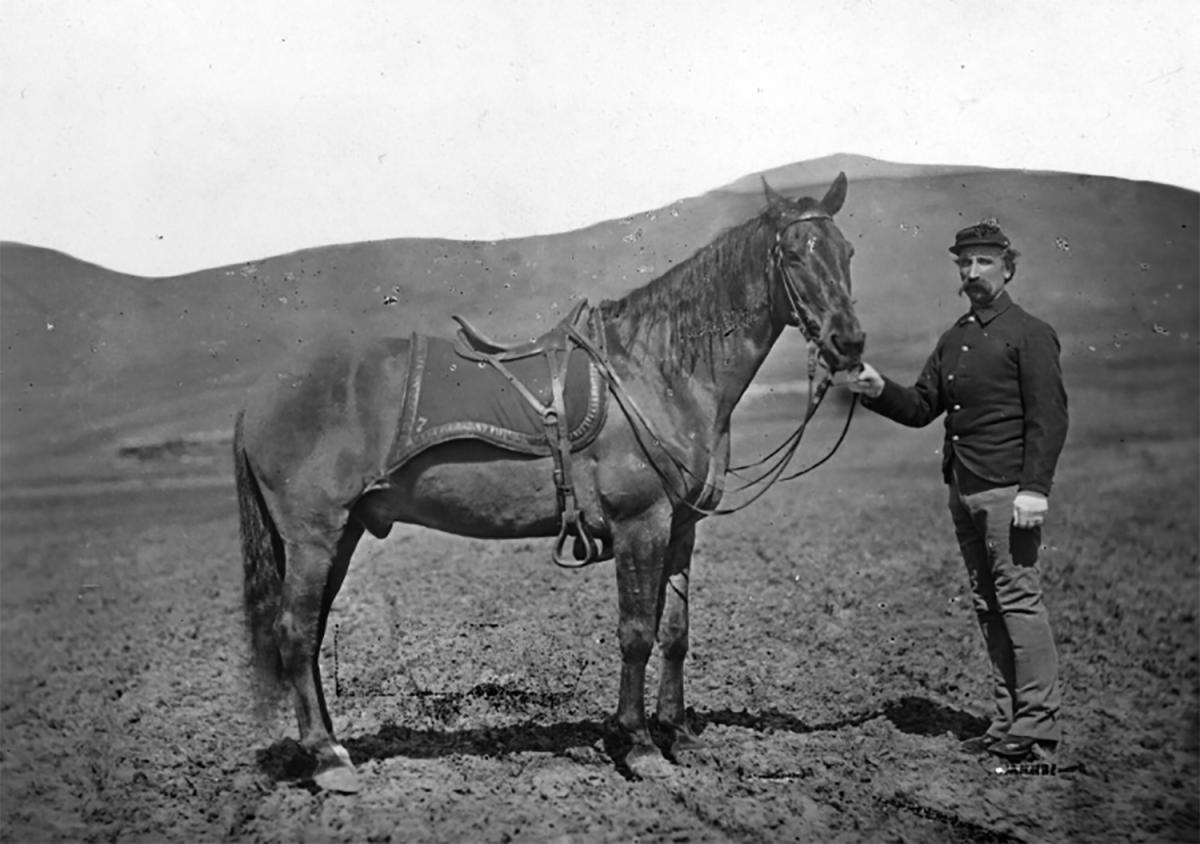
Comanche was discovered by a member of Keogh's company who recognized the officer's mount. The soldier, named Francis Kennedy, rushed to obtain an order to stay Comanche's shooting. He washed the horse's wounds out with water from a kettle. Kennedy remembered that the horse had "about twenty wounds, some flesh wounds and some more serious." Comanche was spared. The other horses were executed, with some accounts stating that the animals were skinned and their hides used as makeshift stretchers to carry wounded.
Comanche traveled by wagon to the steamship Far West on the Little Bighorn River, part of a caravan that included between 30 and 52 wounded cavalrymen laid in crude litters, all carried over rocky, uneven terrain. The Far West set out for Bismarck on the evening of July 3, flying her flag at half mast.
Comanche made that trip suspended between the rudders in a large sling. At Fort Abraham Lincoln, he was nursed back to health by a blacksmith named Gustav Korn. Eventually, he was well enough to support the young ladies staying at the fort, among whom Comanche proved a popular mount to take on afternoon perambulations. The tender ladies fought over the right to ride him.
In 1878, Col. Samuel Sturgis pronounced that Comanche, the beloved mascot and "only living representative of the bloody tragedy of the Little Big Horn," should be the subject of only "kind treatment and comfort." "Though wounded and scarred," he wrote, "his very silence speaks in terms more eloquent than words of desperate struggle against overwhelming odds, of the hopeless conflict, and heroic manner in which all went down that day."
Sturgis made provisions that a "special and comfortable stall" be prepared for the horse, and that he would no longer "be ridden by any person whatever under any circumstances, nor will he be put to work."
Comanche, for his part, grew attached to his blacksmith savior Gustav Korn. He was said to follow Korn everywhere and to dote on him especially. He even, according to one tale, followed Korn into town, even onto the lawn of the home of the lady he was courting. When Korn was away, Comanche would neigh repeatedly until Korn would return and accompany the horse back to his stall.
In 1890, fears over the Ghost Dance—a spiritual movement some believed would restore traditional life and drive out white settlers for good—led the 7th Cavalry to detain Big Foot's band at Wounded Knee Creek in South Dakota. There, 153 Native American men, women, and children were massacred. In the rain of fire and bullets, some twenty-five American soldiers died as Natives fought back against the unwarranted attack. One of the American soldiers who lost his life was Gustav Korn.
Comanche may have known enough of war to understand why Korn never came back, or perhaps not. But in his beloved blacksmith's absence, his health began to fail, and he died on November 6th, 1891.
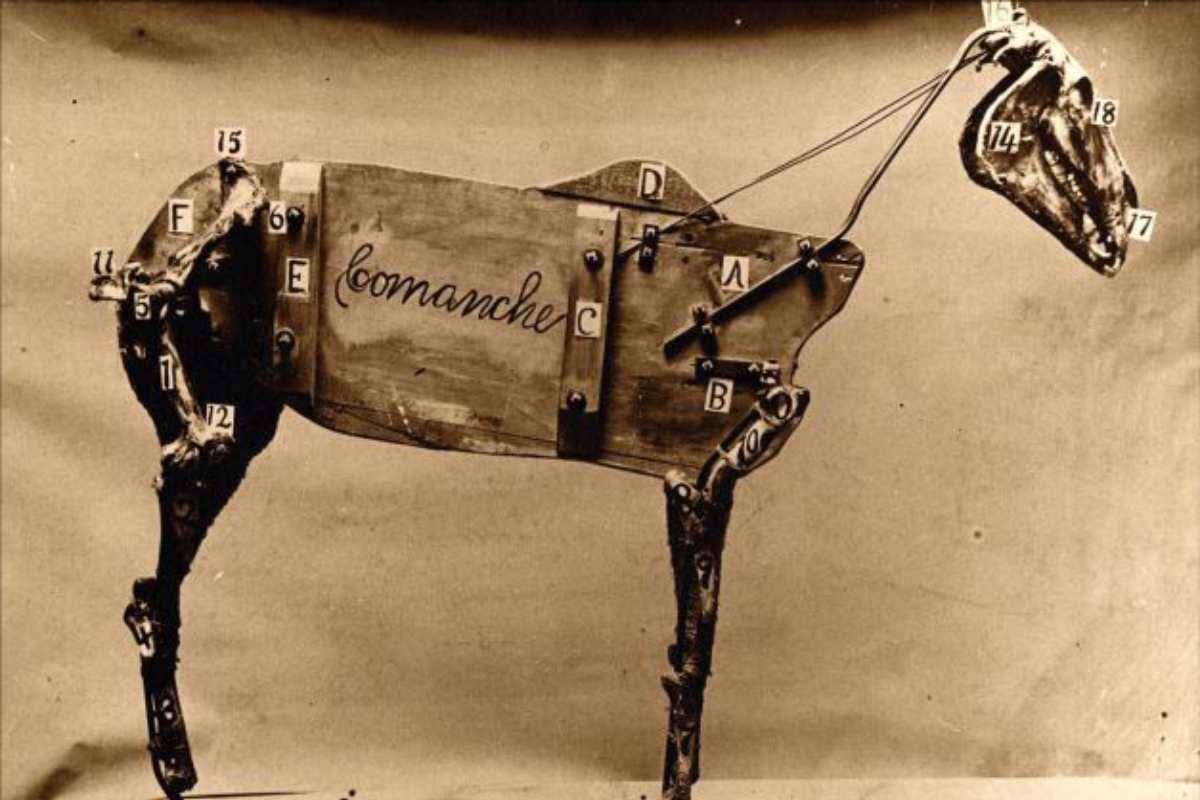
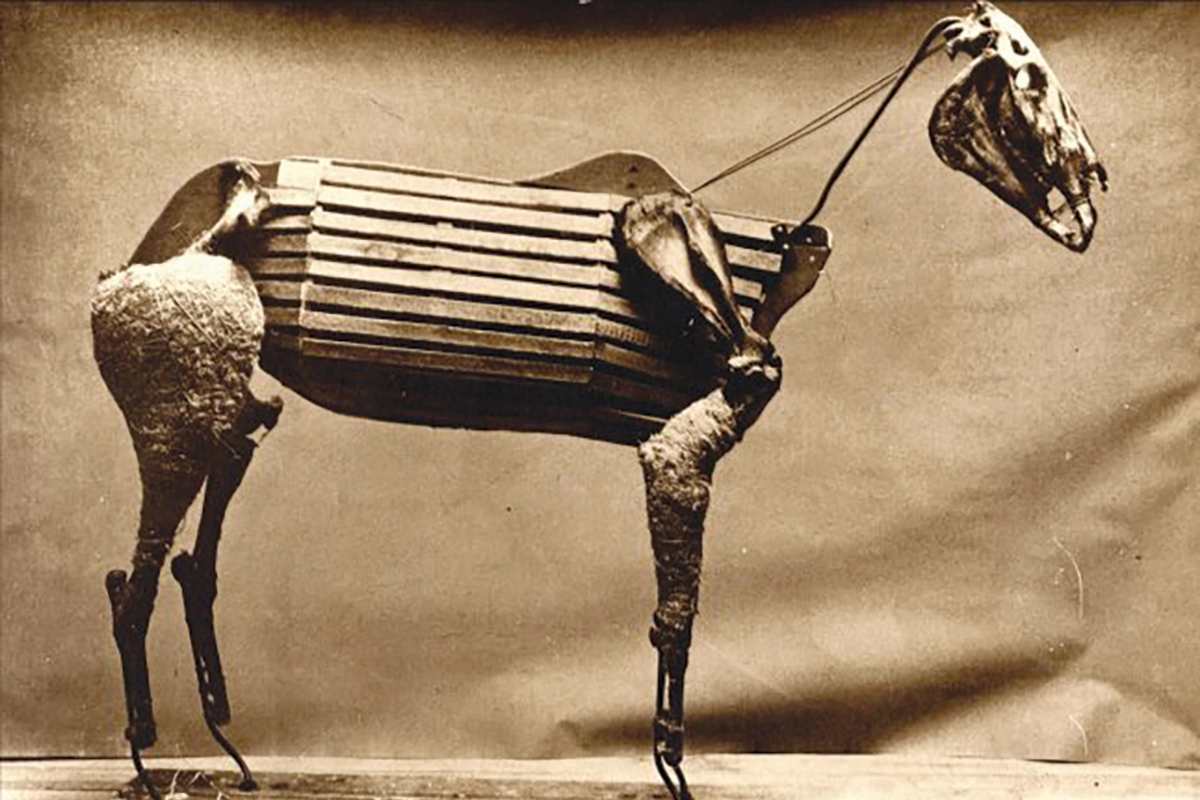
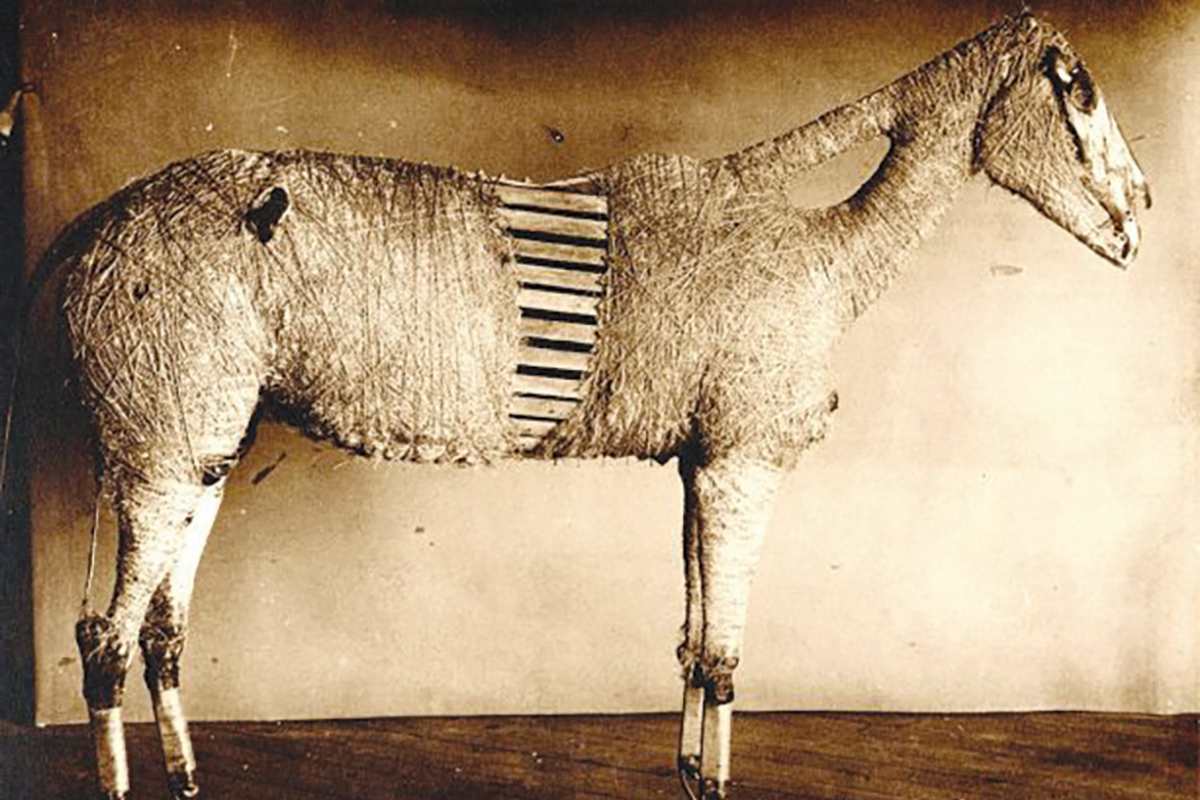
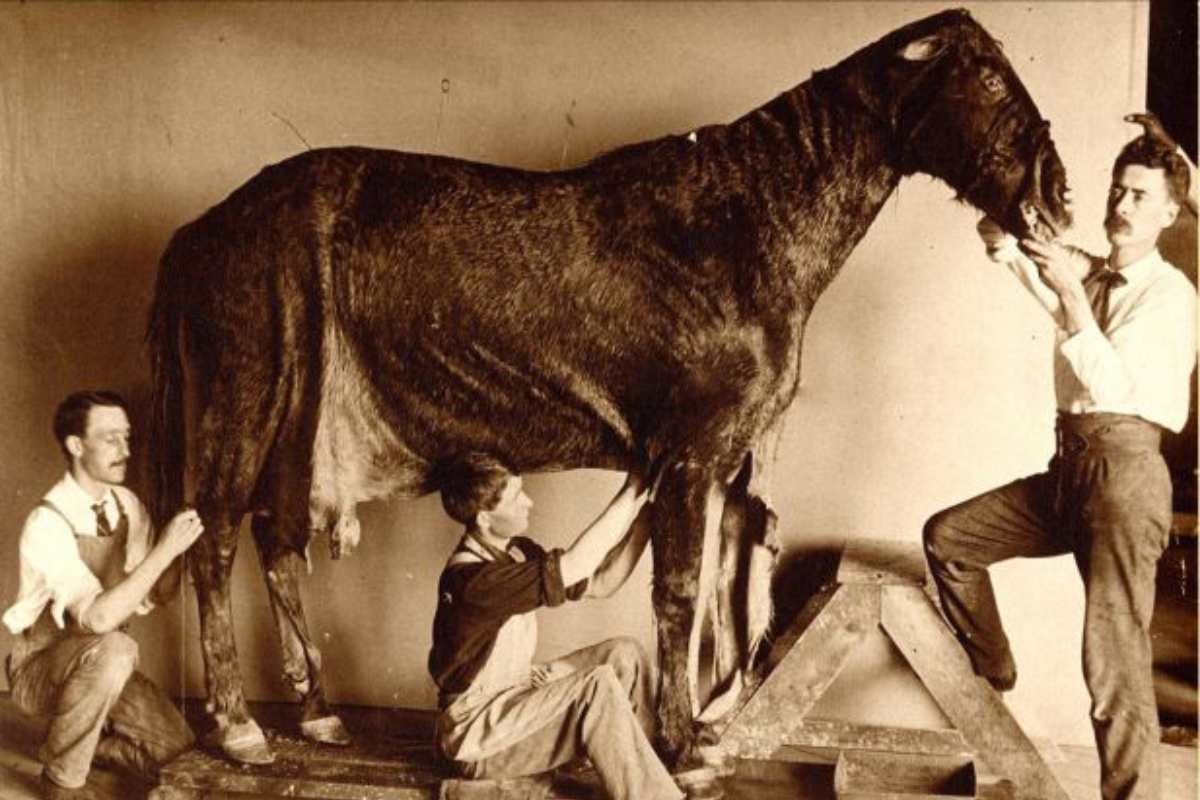
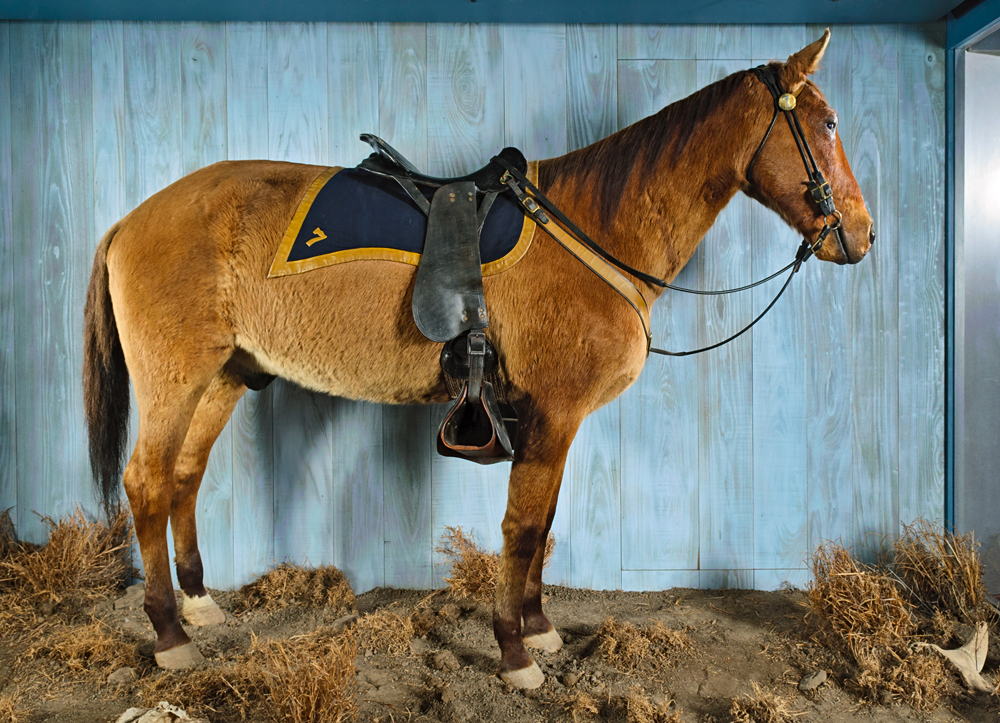
Comanche was stuffed and mounted at the behest of a naturalist at the University of Kansas who thought the animal would make a nice display. He was skinned, and his coat mounted on a dummy artfully arranged to look real, carefully mutilated and reassembled in the verisimilitude of his wartime glory. He went on display at the 1893 Chicago World's Fair before ultimately being ensconced inside a large humidity-controlled display case at the Museum of Natural History at Dyche Hall in Lawrence, Kansas.
LISTEN TO THIS ARTICLE AS AN EPISODE OF OUR PODCAST, "DISTINCTLY MONTANA STORIES:"
Enjoyed this story?
Montana has more layers than most people ever see.
Distinctly Montana finds them, four times a year. Subscribe and get every issue.
- Reply
Permalink