By Joseph Shelton, Ledger Art by Red Horse Courtesy of The Smithsonian |
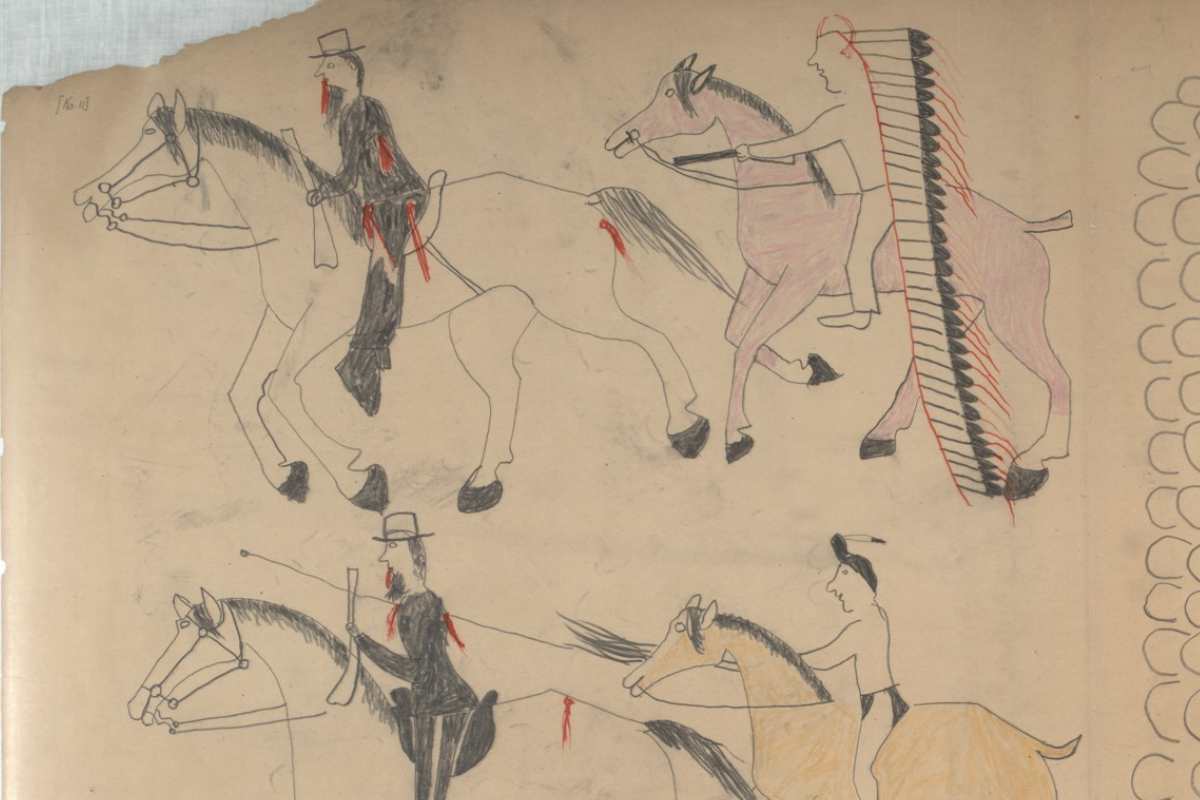
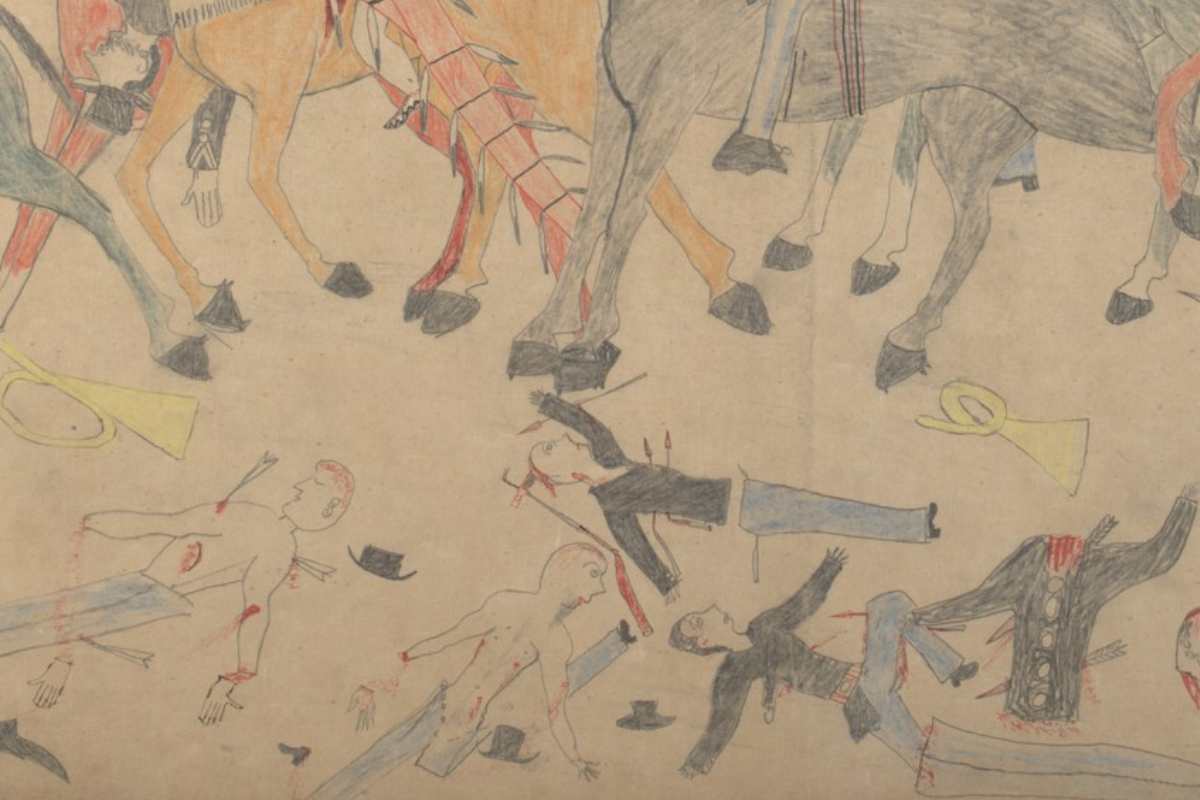
Detail from National Anthropological Archives, Smithsonian Institution, "Warriors charging U.S. soldiers at Battle of Little Bighorn," Folder 4 (2367A_08568800)
When Walter Campbell—the Oklahoma historian and novelist better known as Stanley Vestal—sat with the Minneconjou Sioux White Bull, he was talking to his adopted father, his historical source, and a fellow man of war, all at once. White Bull had fought at the Battle of the Greasy Grass. Campbell, too, knew a little something about fighting. He had fought in the Great War, serving as a battery commander for Batteries F and A of the 335th AEF 87th Division.
As Raymond DeMallie wrote in the foreword to Campbell's book Warpath, about White Bull's experiences, "Both had been trained to fight in their youth, the one in the Indian wars, the other in World War I. Both savored the excitement of war, the courage of the individual fighter tested to the limit. Such a collaboration, of course, results in a composite view—the interpretation by an outsider with literary skills..."
They discussed everything, but their favorite subjects were the particulars of Plains Indian life, the historical events White Bull had witnessed, from the Battle of the Rosebud to the Battle of the Little Bighorn.
Lame White Man was one of only seven Cheyenne casualties at the Battle of the Greasy Grass. White Bull was Minneconjou Sioux and would have known Lame White Man's Sioux names, which were Bearded Man or Mustache. White Bull himself was the eldest nephew of Sitting Bull, who, along with the Battle of the Greasy Grass, was also frequently the subject of the two men's discussions.
Historian Richard G. Hardorff, in his book Indian Casualties of the Custer Fight, includes a footnote to a sentence about the Cheyenne War Chief Lame White Man's seemingly foolhardy attack on Custer's line: "This reckless charge by the Cheyenne leader was confirmed by the Minneconjou, White Bull, who was astonished and then appalled by the apparent senseless act. This shocking incident was sealed forever in White Bull's mind. Half a century later, he told his friend, Walter Campbell, that this was the only time that he had ever seen a man 'throw his life away.'"
On the night of June 24, 1876, four Cheyenne youths watched as a group of Sioux men took the suicide vow, promising to die in the next day's battle against Custer and his soldiers. The Dying Dancing ritual was performed. Moved by what they saw, they decided that they, too, would die tomorrow.
Their names were Cut Belly, Closed Hand, Little Whirlwind, and Noisy Walking. Little Whirlwind and Noisy Walking were 16, but Closed Hand and Cut Belly were 20 and 30 years old.
The next day they were honored by a parade. According to surviving accounts, as they walked through the encampment, two old men walked on either side of the procession intoning, "Look at these men for the last time they will be alive; they have thrown their lives away." Around noon, Reno's men attacked the village and the battle began. It only lasted around 20 minutes, according to White Bull.
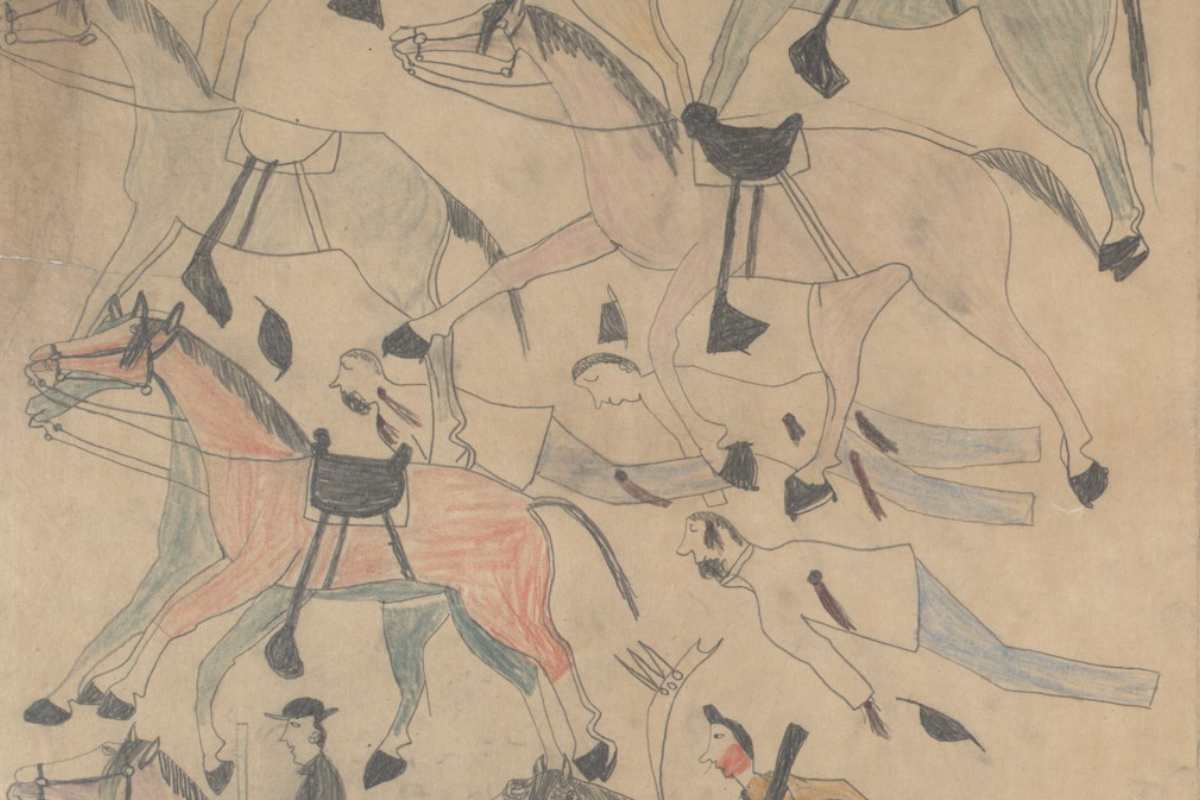
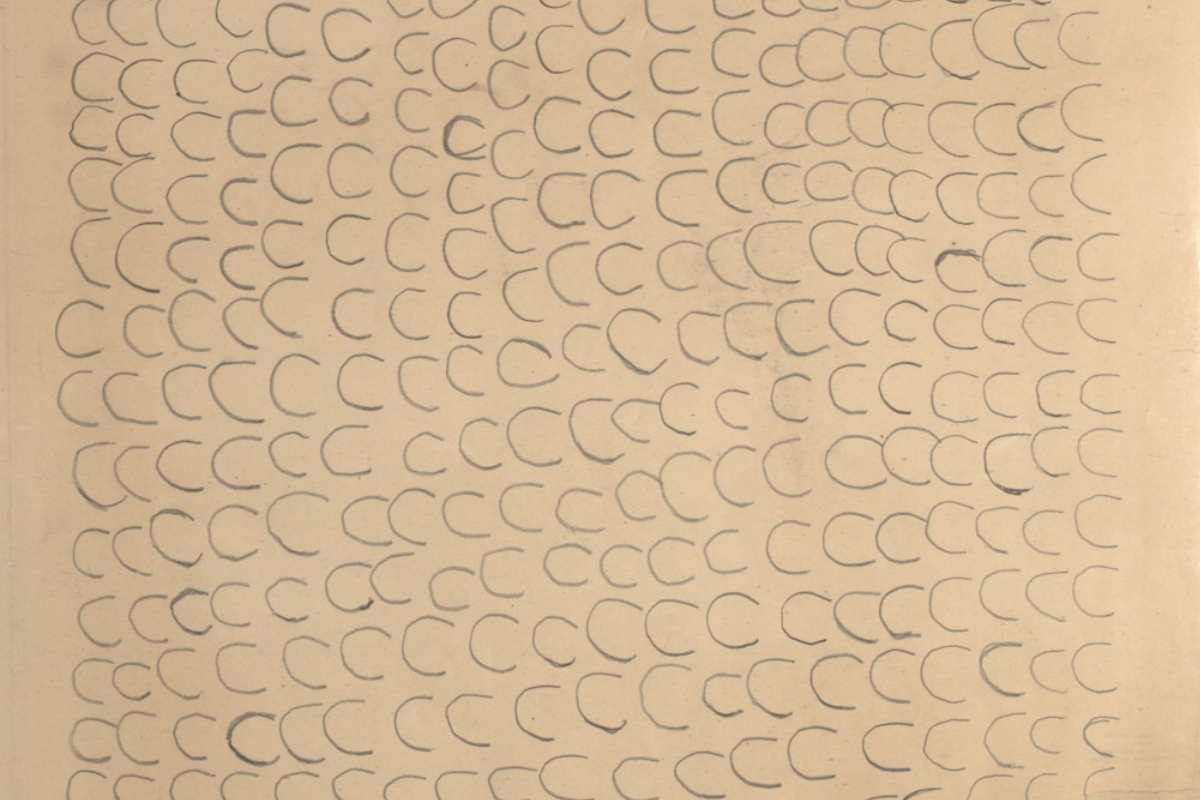
Detail from National Anthropological Archives, Smithsonian Institution, "Warriors charging U.S. soldiers at Battle of Little Bighorn," Folder 5 (2367A_08569000)
What exactly happened to the Suicide Boys between the end of the parade and the end of the battle is unclear, but we are able to tell the broad strokes: three, Little Whirlwind, Closed Hand, and Cut Belly, would die on the battlefield, and the fourth, Noisy Walking, would die in his father's lodge that night. They had all honored their vow.
Near the end of the battle, Custer's men had gathered on Last Stand Hill. For the time being, they had cartridges and were able to hold the Indians at bay. What was needed to defeat Custer would be for someone to charge the hill and break the firing line, distracting the soldiers just long enough for the rest of the Sioux and Cheyenne warriors to advance on them. After that, it would be only minutes before the fighting would be over.
Sioux men rode along the lines of warriors, shouting for them to watch for the Suicide Boys. When they attacked, they told the others to crowd in alongside them so that Custer and his men would have no room to shoot. As they rode, the men repeated the instructions. The Cheyenne warriors who didn't know the language had it explained to them by Sioux who did. Then, the charge of the Suicide Boys began, as they rode, scattering the field of the white men's loose horses, and headed directly for Custer and his men.
As the melee began, Yellow Nose, a Cheyenne fighter who Stands in Timber interviewed for Cheyenne Memories, was "in there close:"
"The dust was so thick he could hardly see. He swung his horse out and turned to charge back in again, close to the end of the fight, and suddenly the dust lifted away. He saw an American flag not far in front of him, where it had been set in the sagebrush. It was the only thing still standing in that place, but over on the other side, some soldiers were still fighting. So he galloped past and picked the flag up and rode into the fight, and he used it to count coup on a soldier."
Two Indian horses collided. One white soldier brandished his rifle as a weapon, swinging it so hard that he and his target both fell over. If one of the soldiers managed to get a shot off, he certainly didn't have time to reload.
And, somewhere in the center of the tumult, the Suicide Boys were engulfed in dust and fire and blows. Little Whirlwind is sometimes reported to have been killed earlier, in the attack by Reno, after he and an Arikara fighter both leveled their guns at each other and shot. Both fell. For this reason, some hold that it was not Little Whirlwind, but Limber Bones who was the fourth Cheyenne Suicide Boy. Limber Bones was killed just below Last Stand Hill, near where Closed Hand was found. Cut Belly was shot down near where the Stone House stands now, and died a few days later at Powder River. Noisy Walking was shot and stabbed through with a bayonet.
The story of the Suicide Boys would not be told to non-Native readers for almost 80 years, when it was published in Stands in Timber's 1967 book Cheyenne Memories, co-authored by Margot Liberty.
Stands in Timber, born in 1884, was a Cheyenne who was orphaned at eight and later adopted by his widowed grandmother and her second husband, Wolftooth, a warrior who fought at the Battle of the Greasy Grass. Indulging a lifelong fascination with the history of his people, Stands in Timber spent decades gathering stories from elders and collecting them in his cabin in Lame Deer. Telling Stands in Timber a story was very different from telling even the most trusted white anthropologist or historian. As outsiders, they could be told about some of the particulars of what happened there, but the most sacred mysteries of their culture would have to be safeguarded for as long as possible. As the former chief historian for Little Bighorn Battlefield told the Billings Gazette, "Maybe the suicide vow was too sacred to be shared with outsiders while the battle was still so fresh."
The Cheyenne Dog Soldiers and the Lakota Brave Hearts exhibited similar characteristics to the Suicide Boys; the Dog Soldiers would "pin" themselves to the ground with a rope and pin and not move from the spot while they fought until they were killed or their bravery had been proven. Among the Lakota, the Brave Hearts, whose war cry was "hoka hey" and of whom Sitting Bull was a member, would wear sashes that they would doff and stake to the ground while they fought.
The ceremony of the Dog Men, here recounted in the book Cheyenne Memories, possesses some suggestive similarities to the case of the Suicide Boys: "The Dog Men became one of the most fearless of the Cheyenne military societies. Many of them took the suicide vow, or as they called it, 'the old men's charm,' and when they paraded around camp before battle the old men would go on either side of them and the criers would call out, 'Look at these men for the last time they will be alive; they have thrown their lives away.'"
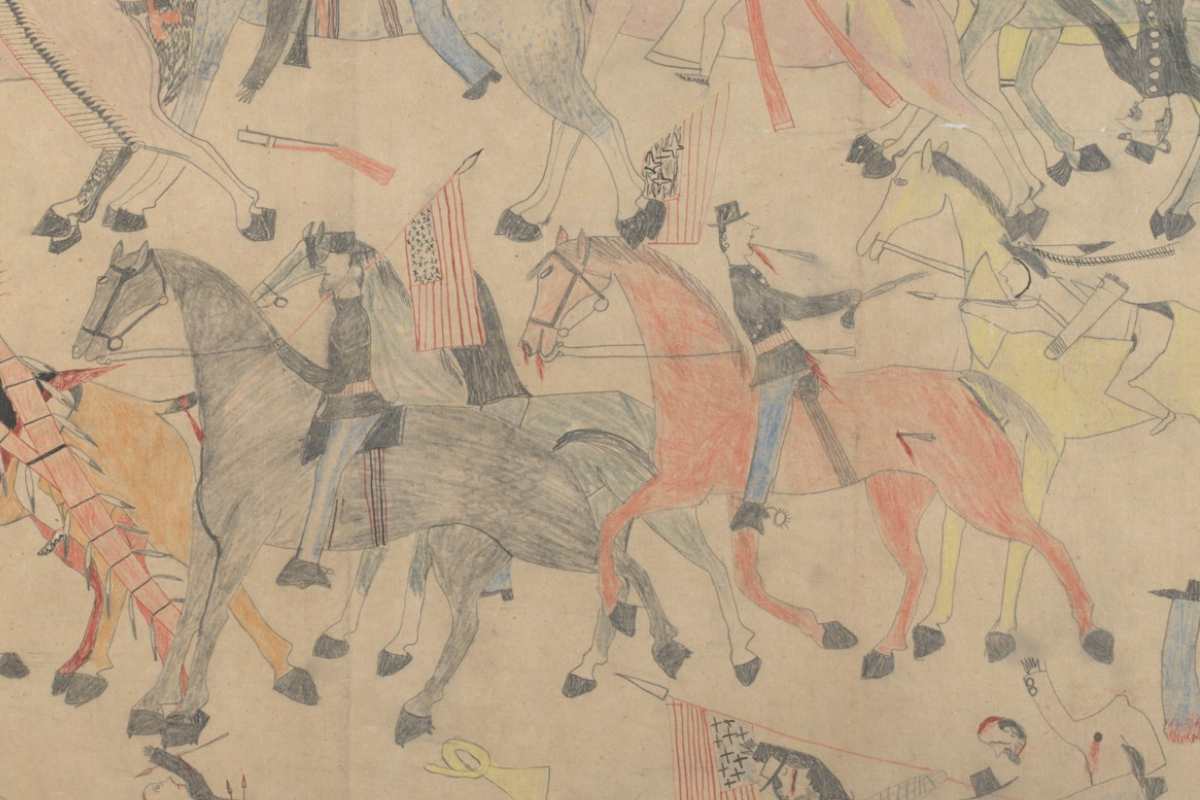
Detail from National Anthropological Archives, Smithsonian Institution, "Warriors fighting Custer's troops at Battle of Little Bighorn," Folder 6 (2367A_08569200)
The Dog Soldiers were also distinct from the Suicide Boys in key ways because the elite warriors, even the ones who did not fix themselves to the ground but made mounted horse charges instead, "quit after a few [passes]. They did not make more than four such charges or passes in the same place." The Suicide Boys, rather, "would keep doing it until they were killed."
Suicide Boys "were always young men...their deaths were remembered. It did not happen very often..." Stands in Timber wrote. But "some important things were won when they sacrificed themselves that way."
Just feet from the place where the mortally wounded Noisy Walking had been found lay a Southern Cheyenne warrior chief named Lame White Man, or Bearded Man in the Sioux language. He was 37 to 39 at the time of the battle—relatively old for a warrior—and was regarded as a tribal or a war chief of the Cheyennes. As a young man of about 25, he had been present at the Chivington Massacre of Sand Creek in Colorado and survived before moving and joining the Northern Cheyenne. A soldier of renown, he was the leader of the Elk Society.
He was married to Twin Woman, with whom he had two children. Her brother, Tall Bull, would be the one to retrieve Lame White Man's body. Lame White Man emerged from a ritual sweat bath when the attack by Reno's men began. Witnesses said he emerged from his sweat and charged into the fray wearing only a blanket and moccasins, gripping his rifle in his hands. His hair, they said, was not braided in the traditional fashion, but was worn loose, as if he had not had time to prepare. In the next few frantic minutes he would lead a charge on Calhoun Hill, routing the enemy soldiers to their final stand at Custer Hill.
In a 1906 interview with Eli S. Ricker, Lakota warrior Respects Nothing remembered "[o]ne Indian dashed right through the soldiers at Custer Hill on horseback."
"I have forgotten whether he said this Indian was killed," Ricker wrote, "but I think he said he was killed." The warrior described was Lame White Man. Wooden Leg's account is unequivocal: "We knew he had gone with the young men in their charge upon the soldiers there."
In Wind on the Buffalo Grass: The Indians Own Account of the Battle of the Little Big Horn River & the Death of their Life on the Plains, author/editor Leslie Tillett reports that Kate Bighead, a Cheyenne woman and the aunt of Noisy Walking, saw the "white men dismounted" to "hide along a second ridge. There were hundreds" of Sioux and Cheyenne "surrounding this second ridge. One of the bravest Cheyenne warriors, Chief Lame White Man, was leading them."
His body was found on the west slope of Custer Hill. Historian Richard G. Hardorff writes that "Examination of the remains revealed a gunshot wound in the right breast, the bullet having exited from the back. The scalplock was removed, and the trunk showed additional mutilation from repeated stabbings." Someone (perhaps Standing Bear, according to Black Elk Speaks, or perhaps, according to an interview with Stands in Timber in 1956, Little Crow, brother of Chief Hump) had mistaken him for one of Custer's Arikara scouts and taken his scalp.
Detail from National Anthropological Archives, Smithsonian Institution, "Warriors fighting Custer's troops at Battle of Little Bighorn," Folder 6 (2367A_08569200)
Taken in this context, maybe the reason for Lame White Man's hair being down wasn't haste at all. Another of Hardorff's footnotes: "It should also be noted that among the Lakotas the practice of wearing one's hair loose in combat signified that the wearer was prepared to fight to the death."
Could it be that Walter Campbell/Stanley Vestal* had heard a sentence with the words "throwing lives away" and assumed White Bull had meant the phrase in the standard prosaic, if negative, Anglo-American sense of the phrase? After all, we throw away trash when it is mere refuse. When we say we have squandered an opportunity, we call it throwing it away. It must have sounded to Campbell as if White Bull were describing a "wasted life."**
There is perhaps one exception in English literature, and it nearly catches the Plains Indian sense. It comes from William Shakespeare himself. In Macbeth, he writes that the Thane of Cawdor "died as one that had been studied in his death, to throw away the dearest thing he owed as 'twere a careless trifle," though for the traitorous Thane, the death redeems rather than consecrates.
And is it possible that what stuck in White Bull's mind wasn't an "appalling" sense of having witnessed an "apparent senseless act" or a "shocking incident," but something closer to profound admiration at having witnessed not just a brave act, but a sacred one? In this sense, "throwing your life away" describes something which, to the participants and observers, must have been sacrosanct.
If so, Lame White Man died in his state of undress and unadornment because he had no need of anything but his blanket and moccasins, his gun, and his loose hair.
He may not have made the vow at the same time as the Suicide Boys, or had the vow observed by the members of his tribe as they paraded him through the village, but nevertheless, Lame White Man had decided, in the words of the Sioux battle cry, that it was a good day to die.
This summer, thousands of people from all over the world will see, without quite understanding, the spot where Noisy Walking and his young compatriots joined with a war chief of the Cheyenne in the holy act of throwing their lives away one afternoon, 150 years ago.
*For that matter, the name of the Suicide Boys most likely represents another cross-cultural failure of translation. The West almost never calls spiritually-tinged self-sacrifice "suicide."
**Or is the error Hardorff's and not Campbell's? Hardorff says the quote about "throwing" Lame White Man's "life away" appears in Box 105, Notebook 5 of the Campbell collection at the University of Oklahoma. Kindly, helpful archivists have sent scans of those files, but we were unable to find it (though we did find Mustache mentioned in White Bull's list of Indian casualties in Notebook 24 of Box 105). Even so, the specificity of the "throwing" phrase suggests that White Bull did say it, and that somewhere between his mouth and Hardorff's pen, it was (mis)interpreted as a wasted life.
Detail from National Anthropological Archives, Smithsonian Institution, "Warriors charging U.S. soldiers at Battle of Little Bighorn," Folder 5 (2367A_08569000)
Enjoyed this story?
Montana has more layers than most people ever see.
Distinctly Montana finds them, four times a year. Subscribe and get every issue.












Leave a Comment Here