Doug Schmittou

Doug Schmittou

Doug Schmittou resides in Billings and is a freelance writer. His research focuses on travel in the Northern Rockies, evidence-based wellness protocols, and nineteenth-century Plains Indian art, material culture and ethnohistory. Previous publications appeared in Montana The Magazine of Western History, Plains Anthropologist and American Indian Quarterly.
  • Larch Madness: Fall-Foliage Destinations in Northwestern Montana

    By Douglas A. Schmittou
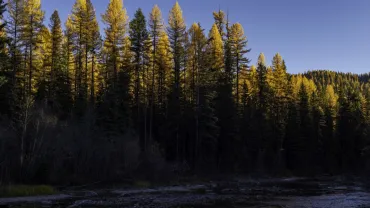
    At peak color, the contrast between their foliage and dark green coniferous forests, set against the backdrop of Montana’s majestic mountains and brilliant blue skies, is absolutely breathtaking, surpassing anything that New England can offer.
  • Profiles in Valor

    By Douglas Schmittou
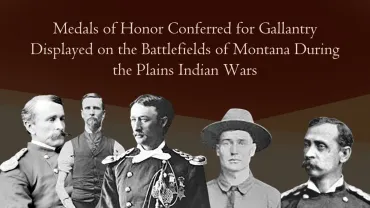
    The largest Medal of Honor award ceremony in Montana history occurred on July 18, 1877, at Cantonment on Tongue River, where General William T. Sherman pinned medals on the dress coats of 31 enlisted men, all of whom served under the command of Colonel Nelson Miles during the winter campaign of 1876-1877.
  • The Lakota Delegation: Portraits from 1868 - 1877

    By Douglas Schmittou
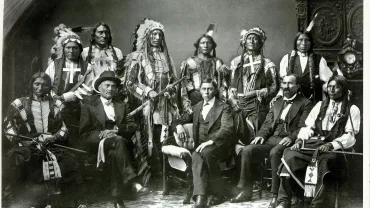
    Studio photographs of Spotted Tail’s wife and Running Antelope, a Hunkpapa headman, were taken by Gardner in Washington, D.C., during 1872. Running Antelope was splendidly dressed in a magnificent quilled shirt, peace medal, dentalia-shell ear pendants, otter-fur hair wraps, and three eagle feathers, one of which bears specific war-exploit markings.
  • When Death Rode a Pale Horse

    By Douglas Schmittou
    This invisible assassin crossed the Rio Grande by late 1780 or early 1781, when it infected the Comanches, most probably through contact with Spanish traders in Texas and New Mexico. Far to the north, traders reported its presence among the Assiniboines and Crees in October 1781. As historian Theodore Binnema observed, “Never before had so large a portion of the population of the plains faced such a calamity.”
  • When Steamboats Ruled Montana's Waters

    By Douglas Schmittou
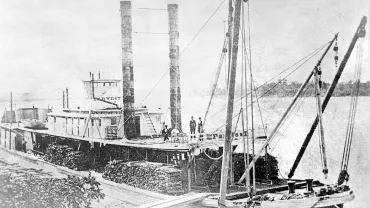
    Christened the Yellow Stone, its voyage in 1832 was, according to Hiram Martin Chittenden, a “landmark in the history of the West. It demonstrated the [feasibility] of navigating the Missouri by steam as far as the mouth of the Yellowstone, with a strong probability that boats could go on to the Blackfoot country.”
  • The Ice Busters

    By Douglas Schmittou
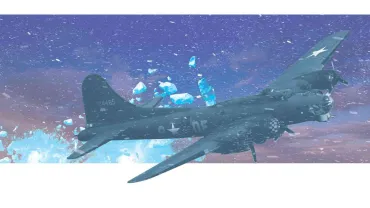
    Published accounts generally concur that aerial bombardment of the ice jam commenced at approximately 7:30 p.m. and was conducted at an altitude of 2,200 to 2,600 feet. An article published in The Billings Gazette on March 22nd specifically indicates that sixteen "250-pound bombs [were dropped] along a five-mile ice gorge." Destruction of a target that large by one bomber with conventional ordnance would, presumably, have required strategic use of the intervalometer.
  • The White Swan Robe: A Tribute to Anonymous Nineteenth-Century Plains Indian Artists of Montana

    By Douglas Schmittou
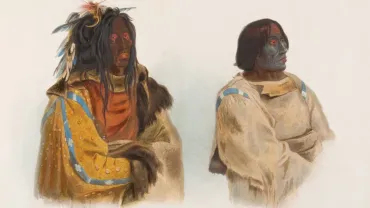
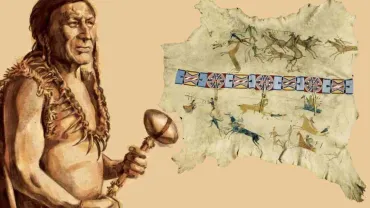
    The most prolific Crow warrior-artist of his generation, White Swan was one of six Crow scouts detached to Lt. Col. George A. Custer's regiment on June 21, 1876. White Swan saw extensive combat in the Battle of the Little Bighorn, where he was severely wounded. He recovered sufficiently from that conflict to chronicle his military career in artworks. This robe, however, was devoted primarily, if not exclusively, to honors achieved in intertribal warfare.
  • The Little Ice Age in Montana: Its Environmental and Cultural Impact

    By Douglas Schmittou
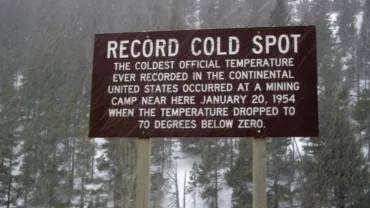
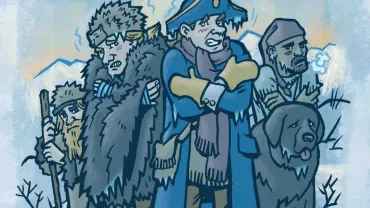
    The Corps of Discovery did not enter present-day Montana until April 28, 1805, but journal entries made during the winter of 1804-1805 at Fort Mandan (North Dakota) chronicle the severity of conditions that existed then on the northern plains. They experienced a 13-inch snowfall on November 29, the coldest weather of their trip on December 17 (-45°F), and a ten-day period (January 5-14, 1805) during which overnight lows averaged -24°F.
  • The Odyssey of Hugh Glass: A Bicentennial Tribute

    By Doug Schmittou, with illustrations by Rob Rath
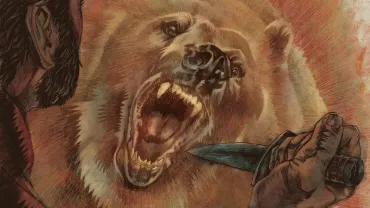
    Cooke’s graphic description indicates that the bear’s claws literally scraped flesh from the bones of the shoulder and thigh. George C. Yount’s narrative strongly suggests that another wound perforated the windpipe, which spurted a “red bubble every time Hugh breathed.”
  • Chief Mountain: Iconic Landmark and Sacred Site

    By Doug Schmittou
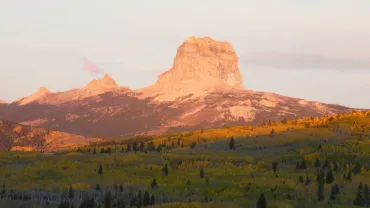
    In September 1892, however, Stimson was a member of the first non-Indian party to climb Ninaistákis. At its summit, they discovered evidence of the mountain's long history of ceremonial use. On terrain far too rugged for bison to traverse, three bison skulls were found, two of which were so old "that the black sheaths of their horns had been worn away by winds and storms, and the sheaths of the other horns had turned from black to yellowish white." 
  • The Crazy Mountains: Montana’s Less-Heralded Alternative to the Tetons

    By Doug Schmittou, with photos by Robert Schmittou
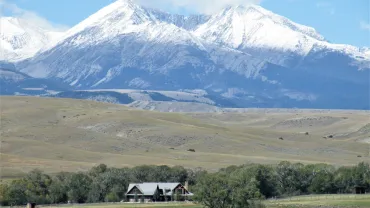
    Encompassing an area roughly 30 by 15 miles in size, the Crazies are Montana’s most impressive island range. With 23 summits that exceed 10,000 feet in elevation, the highest of which is Crazy Peak (11,214 feet), the Crazies also are Montana’s third-highest mountain range.
  • Montana’s Annual Autumnal Gold Rush

    By Douglas A. Schmittou
    If Mother Nature then chooses to fully cooperate, visitors to Glacier National Park may conclude that Montana’s annual autumnal gold rush surpasses even New England’s fabled fall color, given the grandeur of Glacier’s mountains and the stark contrast between color values that characterize fall foliage in the northern Rockies.