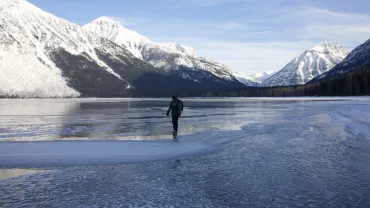
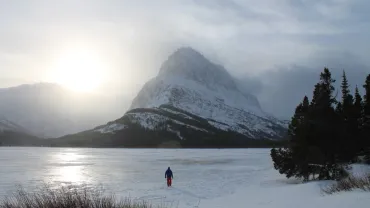
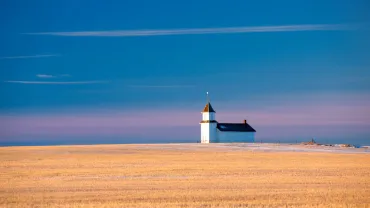
Winter is a most elegant time in Glacier Park with a landscape that appears donned with feathers, furs and jewels. On a sunny day evergreen trees appear to be cloaked in white sequins and frost forms a delicate lace on bony branches.
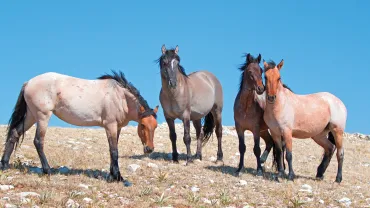
Confined to the 39,000 acres that is the Pryor wild horse range, these horses are wedded to the landscape. Many are clothed with the very colors of the Pryor Mountains themselves. Horses the color of dampened limestone, faded grass, and mudstone.
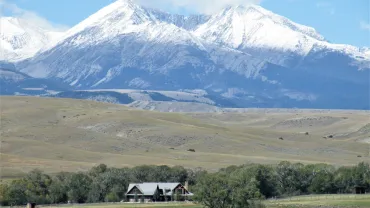
Encompassing an area roughly 30 by 15 miles in size, the Crazies are Montana’s most impressive island range. With 23 summits that exceed 10,000 feet in elevation, the highest of which is Crazy Peak (11,214 feet), the Crazies also are Montana’s third-highest mountain range.
With 9,000+ foot peaks surrounded this untamed area that’s home to countless elk, moose, a smattering of wolverines, black bears, mountain lions, and the rumored grizzly. For those seeking adventure or solitude, the Little Belts are the place to be.
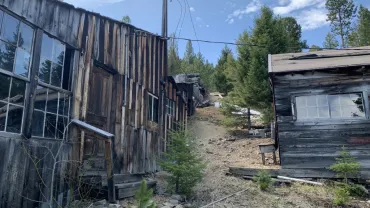
The crucial role of the Anaconda Copper Mining Company and other big mining enterprises in World War II materials production is widely appreciated. Less so is the contribution of Montana’s many small-scale mine operations.
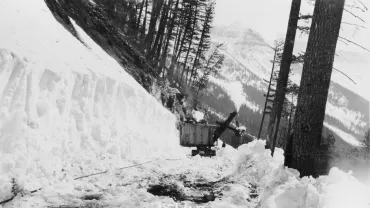
It took about 20 years and a lot of engineering to build the road connecting the east to the west sides. Some men quit when they saw the icy heights they’d have to climb.
These are some of my most favorite drives in Montana, regardless of the season. But I think they can be appreciated even more so in the colder months of the year. So, grab your Thermos of hot cocoa, an extra warm blanket or two, and your best winter tires. Let’s go for a drive.
Montana’s Rocky Mountain Front lies to the west of Highways US 89 and 287 from the southern border of the Blackfeet Reservation to south of Augusta. It is where the northern Great Plains meet Rocky Mountains in a dramatic convergence of cliffs and rolling grassy hills.
It’s practically impossible to mention a winterkeeper’s position without thinking of The Shining, but aside from the wind sounding like people singing down the halls of the grand old hotel, David assures us it is far more grounded. Barely skipping a beat from his summer work, he had plenty to accomplish when the guests were gone.
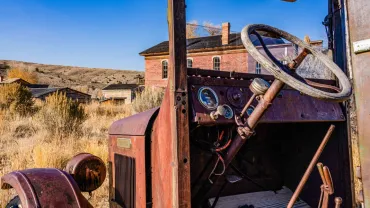
The early history of Bannack is very “colorful” and reads like a Hollywood western. With Virginia City also booming to the north, there was an active stage line between the two gold towns.
After teetering on obliteration for years due to human pursuit of the almighty dollar, Crow Creek Falls has been returned to its natural splendor, much to the appreciation of future generations.
Old bridges are ubiquitous in the Montana landscape and are often taken for granted by motorists. Montana currently has a little over five thousand bridges on its Interstates and primary, secondary, and county roadways.
The name Montana conjures up cowboys herding cattle on the open prairie, and gunfighters hiding out in canyons to hide from rope-swinging vigilantes. But does Montana summon images of the lone sheepherder tending his flock and enduring days of solitude, bitter cold and the intense summer heat?
Then, brooding at the hotel in East Glacier, he overheard the conversation about wildflowers. “It won’t look like this after the sheep are allowed to eat it all up for a sack of silver,” Albright told the men. Intrigued, they encouraged him to explain. One of them, it turned out, was Walter G. Hansen, owner of a meat-packing facility in Butte, Montana.
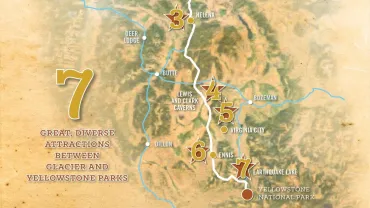
The road between Yellowstone and Glacier offers the less rushed traveler ample opportunities to discover Montana’s renowned “big sky”, its beautiful mountains, blue-ribbon trout streams, as well as its rich cultural heritage, making the drive between the two parks a much more enjoyable and enriching experience.
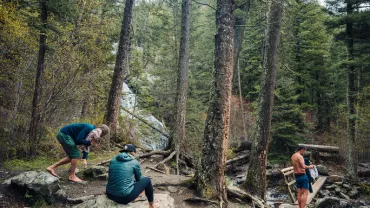
But “best” is a subjective quality, and the attractive bits of a waterfall are not always enough to mitigate the unattractive bits—namely, people. Yes, people. Hordes of them. They make waterfalls deeply unappealing to people like me—namely, misanthropes.
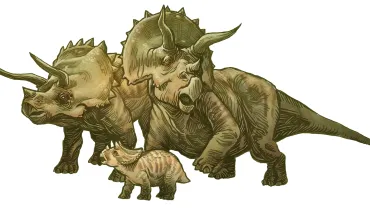
Sixty-six million years ago the earth was going through a transition. The climate was changing, and Montana was shifting from a sub-tropical to a more arid environment.
Members of Montana’s Native peoples called it the “Medicine Line,” the White people’s invisible trace of the 49th parallel. They knew that the “medicine line” offered safety from pursuing U. S. military units bent on forcing them onto reservations in the late 19th century.
But a family saw the next best thing at Leigh Lake, southwest of Libby, when they noticed a large piece break off the ice field and into the ordinarily placid waters of the lake. Soon the family noticed a five-foot wave heading towards them -- not a common sight in the wilds of Montana.